How To Responsibly Enjoy Hokkaido’s Flying Fairy The Enchanting Ezo Momonga
This article is an English translation of the original Japanese article. Read the original Japanese version.
The Ezo momonga, a tiny flying squirrel found only in Hokkaido’s forests, has captured the internet with its huge eyes and fluffy coat. Learn what makes this elusive “snow fairy” so special, where you might spot one in the wild, and why experts say it should never be kept as a pet.
Key takeaways
Q. Where is it easier to observe Ezo flying squirrels?
They are often seen in areas like Biei, Furano, Higashikawa (around Shirogane Blue Pond and Tokachidake), and forests near Kushiro Marsh and Lake Shikotsu.
Q. Is there a recommended time or season to observe Ezo flying squirrels?
Winter mornings and evenings, when leaves have fallen, are best. They become active just before sunset, making that time ideal.
Q. Is it allowed to capture or keep Ezo flying squirrels as pets?
Capturing or keeping them is prohibited by wildlife protection law. Even injured individuals cannot be kept or cared for without permission.
Meet the Ezo Momonga, Hokkaido’s Snow Fairy
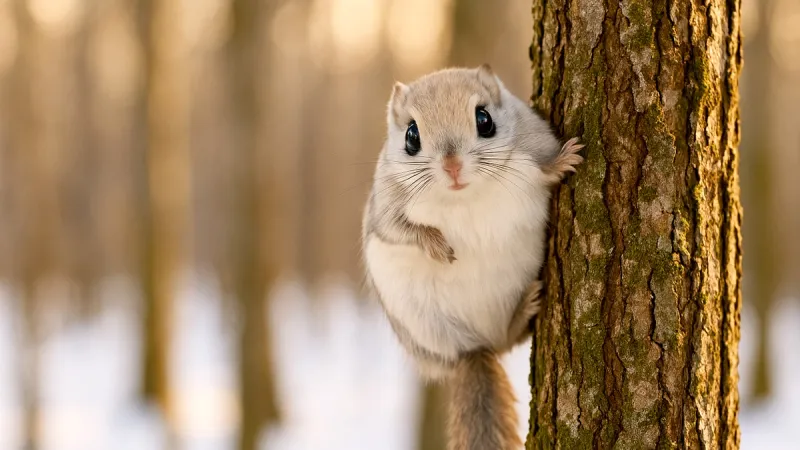
The Ezo momonga is a species of flying squirrel found only in the forests of Hokkaido, Japan. Its body is just about 15 cm long, and even with its tail it barely exceeds 20 cm, making it truly palm sized. Compared with the Japanese dwarf flying squirrel, it is even more petite, with round, dark eyes that seem almost too big for its tiny face.
This combination of small size, plush fur, and expressive eyes has earned the Ezo momonga a reputation as a “forest fairy” among nature lovers and wildlife photographers.
How the Ezo Momonga Glides Through the Forest
Like other flying squirrels, the Ezo momonga has a patagium, a thin gliding membrane of skin that stretches between its front and hind legs. When it leaps from a tree and spreads its limbs, this membrane opens like a paraglider wing, allowing the animal to glide softly from trunk to trunk.
This gliding ability is not just cute to watch. It helps the Ezo momonga move efficiently through the forest canopy, conserve energy, and quickly escape from predators without needing to climb down to the ground, where it would be more vulnerable.
A Nocturnal Life High in the Trees
The Ezo momonga is strictly nocturnal, which means it is rarely active during the day. After sunset, it becomes lively, moving along branches, gliding between trees, and foraging, all while staying mostly above human eye level.
Unlike some small mammals, Ezo momonga do not hibernate. Even in Hokkaido’s deep winter snow, they remain active, relying on their dense, fluffy fur to retain heat. In colder periods, several individuals may huddle together in tree cavities or nest boxes to share warmth and reduce heat loss.
Where You Might See an Ezo Momonga in the Wild
Ezo momonga are distributed across a wide range of Hokkaido’s forested areas, but actually seeing one is largely a matter of luck and timing. Still, some regions are known among local guides and photographers for more frequent sightings.
Well known areas include Biei, Furano, and Higashikawa. In particular, the surroundings of Shirogane Blue Pond and the Tokachidake area are often mentioned as popular observation spots among Ezo momonga enthusiasts. There are also reported sightings in forests around the Kushiro Marshlands and Lake Shikotsu.
For many visitors, the experience is less about guaranteed viewing and more about quietly immersing themselves in Hokkaido’s winter forests, with the chance of a magical encounter.
Best Season and Timing for Observation
The best season to look for Ezo momonga is winter, when deciduous trees have shed their leaves and visibility through the branches is much better. Bare branches make it easier to spot a small silhouette gliding or peeking out from a tree cavity.
They typically become active from just before sunset into the early night. If you plan to observe them, consider arriving a bit before dusk and staying through the early evening, when movement around nest holes and gliding activity are more likely.
If you go, prepare thoroughly for snow and extreme cold. Proper boots, layered clothing, gloves, and head protection are essential for both safety and comfort.
Ethical Wildlife Watching Etiquette
When observing Ezo momonga, quiet behavior and careful use of light are essential. Sudden noises, loud conversations, or bright lights can cause intense stress to these small animals and may disrupt their natural behavior.
Experts recommend that wildlife watchers:
- Keep voices low and minimize sudden movements
- Use red or dimmed lights instead of bright white flashlights
- Avoid flash photography whenever possible
- Maintain a respectful distance from nest holes and perches
By following these guidelines, you help ensure that your presence does not harm the animals or alter their normal patterns.
Why Ezo Momonga Cannot Be Kept as Pets
When photos and videos of Ezo momonga began circulating on social media, timelines quickly filled with comments like “I want one!” and “Too cute not to keep!” The emotional reaction is understandable, but from a welfare and legal standpoint, Ezo momonga are absolutely not suitable as pets.
Under Japan’s wildlife protection laws, capturing or keeping Ezo momonga is prohibited. This applies even to individuals that appear injured or weak. Without official permission and specialized facilities, private rescue or home care is not allowed.
Beyond the law, Ezo momonga are extremely sensitive and prone to stress. They are easily affected by human noise, artificial light, temperature changes, and handling. Creating a captive environment that truly meets their physical and psychological needs is exceptionally difficult, even for experienced professionals.
In other words, even if the law allowed it, experts would still consider Ezo momonga unsuitable for life in a typical household. The kindest choice for these animals is to admire them as wild creatures, not as potential pets.
Why They Are So Popular on Social Media
The Ezo momonga’s popularity is driven by a combination of its appearance, behavior, and voice. Its round body, plush fur, and shining, beadlike eyes give it a storybook charm. Watching one glide between trees or suddenly pop its head out of a nest hole feels like witnessing a scene from an animated film.
Their vocalizations add to the appeal. Ezo momonga produce small, high pitched calls that sound like “chi chi chi” or “pi pi pi” – almost like the audio version of the word cute. Some observers even record these calls simply to enjoy listening to them later.
In recent years, more people have successfully filmed Ezo momonga at night using high performance cameras and video equipment. These clear, close up images and slow motion gliding videos, shared widely on social media, have significantly boosted the species’ global recognition.
As a fun aside, the Ezo momonga is even featured in the popular Japanese series Zannen na Ikimono (“Unfortunate Animals”), where it is introduced as an animal that is excellent at gliding but clumsy at landing, sometimes bumping into trees. Whether you see that as an endearing flaw or part of its natural charm, it certainly reinforces the sense that this is a creature with a lot of character.
Enjoying Ezo Momonga While Protecting Them
The Ezo momonga is a precious product of Hokkaido’s rich natural environment. Being captivated by its cuteness is completely natural, but it is equally important to remember that it is, first and foremost, a wild animal that deserves respect and protection.
If you decide to go looking for Ezo momonga, treat the experience as a quiet visit to their home. Follow local rules, stay on designated paths, and keep disturbance to a minimum. When you share your photos or videos with others, consider also sharing a message about the importance of conserving their habitat and respecting wildlife.
By doing so, you help shift the conversation from “I want to own one” to “I want to help protect them where they belong.”
Your Role in Safeguarding Hokkaido’s Forest Fairies
Ezo momonga remind us of the gentle connection that can exist between people and nature. For pet parents and pet guardians who already care deeply about animal welfare, appreciating this species from a respectful distance is a natural extension of that compassion.
If your travels ever take you to Hokkaido’s forests, you may be lucky enough to glimpse one of these tiny “snow fairies” gliding through the trees. Until then, you can support them by learning about responsible wildlife watching, amplifying messages about habitat protection, and choosing to value wild animals as they are meant to be free, wild, and wonderfully themselves.
- 03.20.2026
- 04.20.2025