Discover The Japanese Giant Salamander And Its Surprising Relatives
This article is an English translation of the original Japanese article. Read the original Japanese version.
Japan’s giant salamander looks like a creature from another age, yet it still quietly inhabits clear mountain streams today. Explore its ancient origins, cultural legends, and lesser known salamander cousins that reveal just how rich and fragile Japan’s freshwater ecosystems really are.
Meet Japan’s Living Fossil The Giant Salamander
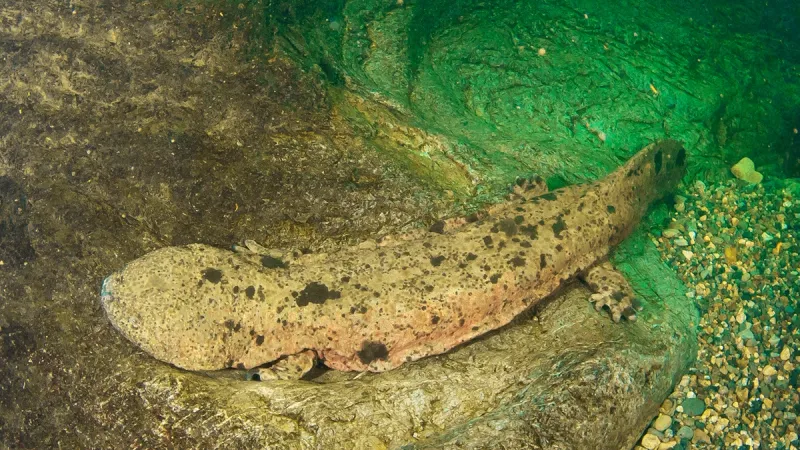
The Japanese giant salamander is one of the largest amphibians on Earth. Most adults reach about 70 to 80 centimeters in length, but researchers have documented rare individuals stretching well over 150 centimeters.
Its common name comes from the distinctive scent of the mucus secreted from its skin, which some people compare to the aroma of Japanese pepper. With its thick, flattened body, broad head, and tiny eyes, the giant salamander looks almost prehistoric, and science supports that impression.
Fossil and genetic evidence indicate that this species has existed in roughly its current form for around 23 million years. Because of this remarkable evolutionary stability, biologists often refer to the Japanese giant salamander as a living fossil. In human care, some individuals have been documented living for around 50 years, highlighting just how long lived these animals can be.
Where Japanese Giant Salamanders Really Live
Many people in Japan immediately associate giant salamanders with Lake Biwa. That association is understandable, because conservation and research efforts are particularly active in and around the Lake Biwa watershed.
However, the natural range of the Japanese giant salamander is much broader. These salamanders inhabit a wide swath of Honshu, especially in western Japan. Clear, cool streams in the Chugoku Mountains and parts of the Kinki region are considered core habitats.
Field studies show that giant salamanders depend on very specific river conditions to thrive. They need:
- Clean, unpolluted water
- Riverbeds with plenty of stones, crevices, and hiding spaces
- Relatively stable water temperatures throughout the year
River engineering, bank concreting, and water pollution linked to human activity can quickly destroy these delicate conditions. As a result, habitat alteration is now recognized as one of the major threats to the long term survival of wild populations.
A Hidden History As Food
It may surprise modern readers, but Japanese giant salamanders were once eaten by people in some mountain communities. Historical records from the Edo and Meiji periods describe them as a valuable source of protein, alongside river fish and wild plants.
Descriptions from the time suggest that the meat was mild in flavor and somewhat similar to river fish. It was reportedly low in fat but rich in gelatinous tissue, giving it a springy, almost jiggly texture. Some accounts compare it to the white flesh of catfish or eel.
Today, the situation is completely different. The Japanese giant salamander is designated as a Special Natural Monument under national law. Capturing, keeping, transporting, or consuming these animals is strictly prohibited. Modern conservation guidelines emphasize that they must be left undisturbed in the wild.
Legends Faith And The Name Hanzaki
In certain regions, the Japanese giant salamander is known by the local names hanzaki or hanzake. Over time, this unusual creature has appeared in folktales, local legends, and even as a motif in traditional festivals.
There are several theories about the origin of the name. One explanation points to the animal’s enormous mouth, which looks as if it could split its body in two. Another theory links the name to an old belief that a hanzaki could survive even if its body were cut in half.
Modern science makes it clear that this belief is a misunderstanding. The ability to regenerate lost body parts is characteristic of some newts, not of the Japanese giant salamander. It is possible that people in the past imagined giant salamanders as extremely old, oversized newts that had grown for a hundred years or more, blurring the line between species in their stories.
Japan Is A Salamander Superpower
Beyond the famous giant salamander, Japan is actually home to more than 20 species of salamanders, making it a hotspot of salamander diversity.
For example, the clouded salamander is widely distributed across Honshu. In spring, it lays jelly like egg masses in rice paddies and small streams, where the larvae develop in relatively shallow water.
The black salamander is adapted to colder climates. It survives in the chilly environments of the Tohoku region and the high mountain areas of central Japan, demonstrating how flexible salamanders can be when it comes to temperature.
The Tokyo salamander is found mainly in the Kanto region. Rapid urbanization and the loss of wetlands and small streams have caused serious habitat decline, and conservation assessments now list it as a threatened species.
In addition, there are highly localized species such as the Hida salamander and the Oki salamander, each restricted to specific regions. Taken together, these species show that Japan is exceptionally rich in salamander diversity, especially when compared with many other countries.
Are Axolotls Related To Giant Salamanders
Many pet guardians remember the 1980s boom in Japan around the so called wooper looper a cute, frilled amphibian that became a pop culture icon. This animal is better known internationally as the axolotl.
Axolotls are native to lakes in Mexico, and their formal name is the Mexican salamander. Taxonomically, they belong to the tiger salamander family, which is different from the family that includes the Japanese giant salamander.
Even so, both axolotls and giant salamanders belong to the order of tailed amphibians, meaning that in a broad evolutionary sense they are distant relatives. They share some basic body plans and life history traits, even though they live in very different environments.
The most famous feature of the axolotl is a trait called neoteny, or paedomorphosis. Axolotls retain their gills and other juvenile characteristics throughout their lives, reaching sexual maturity while still looking like larvae. Most salamanders, by contrast, lose their external gills and move onto land as they mature.
Under typical conditions, axolotls spend their entire lives in the water. However, research shows that under certain specific environmental or hormonal conditions, they can undergo metamorphosis and begin a more terrestrial lifestyle. This flexibility is one reason axolotls continue to fascinate scientists and pet guardians alike.
The Growing Concern Of Hybridization
Habitat loss is not the only challenge facing the Japanese giant salamander. Conservation biologists are increasingly concerned about hybridization with non native relatives.
In particular, the Chinese giant salamander has been imported into Japan in the past, sometimes for food and sometimes for display. When these non native salamanders escape or are released into local rivers, they can interbreed with native Japanese giant salamanders.
This hybridization can blur genetic lines, potentially weakening local adaptations that evolved over millions of years. To address this, conservation groups and research institutions across Japan are working to:
- Monitor river systems for non native salamanders and hybrids
- Protect and restore natural spawning sites for native populations
- Educate local communities about the risks of releasing non native species
These efforts aim to preserve the unique genetic identity of the Japanese giant salamander while also improving overall river health.
Protecting A Symbol Of Japan’s Wild Rivers
The Japanese giant salamander is far more than just a large amphibian. It has become a symbol of Japan’s rich freshwater ecosystems and a living reminder of how long nature has been shaping these landscapes.
Seeing one resting quietly in a clear mountain stream in the Chugoku region or near the Lake Biwa watershed is a powerful sign that clean water, intact riverbeds, and balanced ecosystems still exist there. At the same time, river modification, pollution, and hybridization with non native species show that this balance is fragile.
For people who care about wildlife, one of the most meaningful steps is to support healthy, unpolluted waterways. Choosing lifestyles and community projects that prioritize river conservation helps protect not only giant salamanders but also countless fish, invertebrates, and plants that share their habitat.
By valuing clear streams and diverse local species, we create a future where children can proudly be told, There is a creature in Japan that has survived since ancient times, still living quietly in our rivers today. Protecting the Japanese giant salamander is ultimately about protecting the natural heritage that all of us share.
- 03.02.2026
- 10.01.2025