How To Decode Your Cat’s Coat Patterns In Japanese And English
This article is an English translation of the original Japanese article. Read the original Japanese version.
Your cat’s coat is more than just beautiful fur. Discover how Japanese and English describe the same patterns in completely different ways, and learn the key terms that help pet parents better understand their cat’s looks, heritage, and even cultural symbolism.
Japanese has a long tradition of putting subtle feelings and fleeting scenes into words, a sensibility often described as wabi-sabi. That same sensitivity shows up in how people talk about cats. Everyday objects, familiar colors, and intuitive shapes all become names for beloved feline coat patterns.
In English, by contrast, coat terms tend to sound more technical or classification based. When pet parents compare the two languages, they often discover that the same cat can be described in surprisingly different ways.
In this guide, you will learn the most common Japanese names for cat coat patterns, their closest English counterparts, and what each way of naming reveals about the culture behind it.
How Japanese Describes Cat Coat Patterns
Japanese cat pattern names often come from daily life. They draw on food, animals, numbers, and textures that feel instantly familiar. This makes the names easy to remember and gives each pattern a story.
Below are some of the most widely used Japanese terms and how they relate to English cat coat vocabulary.
Cha Tora
Cha tora literally means “brown or tea-colored tiger.” It refers to orange or warm brown cats with clear stripes. Many pet guardians in Japan associate this pattern with friendly, outgoing personalities, and it is a very common look among companion cats.
In English, this pattern is typically called an orange tabby. The word tabby refers to any striped, swirled, or spotted coat pattern, not a specific color. So an orange tabby is simply a tabby cat whose base color is orange.
Hachiware
Hachiware cats have facial markings that look as if the face has been split by the Japanese character for eight, “八”. A white line runs from the forehead down toward the nose, creating a distinctive, symmetrical pattern. This is a uniquely Japanese way of naming the look, based on shape rather than strict color rules.
There is no exact one-to-one term for hachiware in English. Many hachiware cats are grouped under the broader pattern known as tuxedo.
Tuxedo
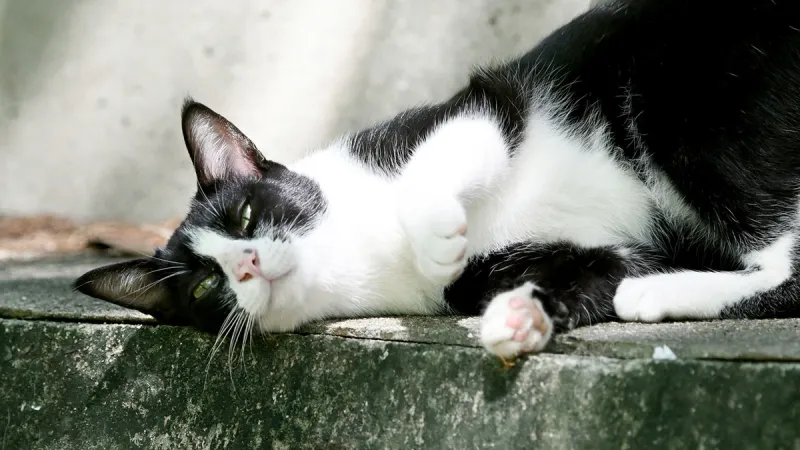
Tuxedo cats have a black base coat with white on the chest, paws, and often the belly, giving the impression of a tiny formal suit. The white chest is compared to a dress shirt, and the white paws to socks or shoes.
In English, tuxedo focuses on the contrast between black and white on the body, not on the specific shape of the facial markings. However, in practice, many hachiware cats are also tuxedos, so pet parents may see both terms used for the same cat.
Kiji Tora
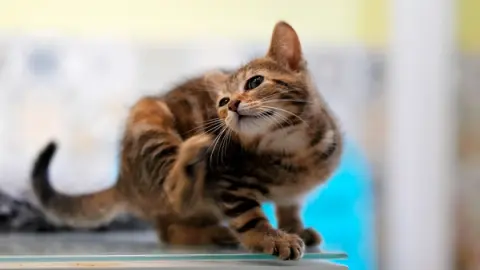
Kiji tora cats have brown and black stripes that resemble wildcats. The name kiji comes from the Japanese word for pheasant, referring to the pattern of the bird’s feathers. This gives the coat a slightly wild, natural impression, even in a relaxed indoor cat.
In English, this pattern is usually called a brown tabby. Brown tabbies are extremely common worldwide and often resemble the classic “striped cat” many people picture when they think of a cat.
Saba Tora
Saba tora cats have silver or gray-based stripes. The name saba means mackerel in Japanese and refers to the silvery, banded appearance of the fish’s body. The comparison is so visually accurate that it has independently appeared in both Japanese and English.
In English, this pattern is often described as a mackerel tabby. Here, mackerel also refers to the narrow, vertical stripes that resemble the lines on a mackerel fish. This is one of the few cases where Japanese and English share almost the same metaphor.
Sabi Neko
Sabi neko are cats whose coats mix black and red or brown in a mottled, patchy way. The word sabi means “rust,” and the pattern is compared to the look of rusted metal. In Japanese folklore and daily life, these cats are sometimes considered lucky and have been cherished for generations.
In English, this pattern is called tortoiseshell, often shortened to tortie. When the same tortoiseshell colors appear together with tabby striping, the pattern is known as a tortoiseshell tabby, or torbie.
Mike Neko
Mike neko, often simply called mike, are cats with white, black, and brown or orange patches. Due to genetics, the vast majority of these cats are female. In Japan, the calico-like mike neko is one of the most iconic and culturally recognizable cat patterns.
In English, this pattern is known as calico. Calico cats also have predominantly white coats with distinct black and orange patches. Many pet parents around the world associate calicos with strong personalities and a bit of attitude.
Buchi
Buchi is a deceptively simple word that can be tricky to translate. It comes from the character for “mottled” or “spotted” and refers to cats with mixed white and black patches. Depending on how the markings fall, some hachiware cats can also be described as buchi.
In English, there is no single everyday word that matches buchi exactly. People might say black and white, piebald, or simply a cat with patches, depending on the context. The Japanese term captures the idea of irregular, scattered markings in a compact, intuitive way.
Coat Terms Common In English But Rare In Japanese
Just as Japanese has pattern names with no perfect English equivalent, English also has several widely used coat terms that are not commonly distinguished in everyday Japanese.
Understanding these can help pet guardians read adoption listings, veterinary notes, and breed descriptions more accurately.
Dilute
In English, dilute refers to a softer, lighter version of a standard color. For example, a dilute calico has pale gray, cream, and soft orange instead of stark black and bright orange. Similarly, a dilute tortoiseshell has muted, smoky tones instead of strong black and red.
You may see terms like dilute calico or dilute tortie in rescue profiles and breed descriptions. These labels help set expectations for a cat’s overall appearance, even when the pattern itself is familiar.
Torbie
A torbie is a mix of tortoiseshell and tabby. In other words, it is a tortoiseshell cat that also shows clear tabby striping. The name combines tortie and tabby.
In Japanese, this look is sometimes described as similar to shima mike (striped calico) or as a variation of sabi, but there is no single, universally used everyday term that matches the English torbie. English speakers, however, treat torbie as a well-established category.
Pointed
Pointed patterns are best known from Siamese cats and related breeds. In these cats, the ears, face, paws, and tail are darker than the rest of the body. The cooler parts of the body develop more pigment, creating a striking contrast.
English uses combinations like seal point, blue point, or chocolate point to describe both the pattern and the specific color of the points. While Japanese cat lovers recognize Siamese-type patterns, the English terminology for points is more standardized and widely used.
Detailed Tabby Types
In Japanese, striped cats are often grouped together under tora (tiger) patterns. Everyday conversation may not always distinguish between different tabby layouts.
English, however, breaks tabby patterns down more precisely:
- Classic tabby has bold, swirling patterns, often forming a bullseye or marble-like design on the sides.
- Spotted tabby shows distinct spots instead of continuous stripes.
- Ticked tabby has individual hairs banded with multiple colors, creating a subtle, sandy or speckled look rather than clear stripes.
For pet guardians, these distinctions can be helpful when reading breed standards or describing a cat’s appearance to a veterinarian or behavior professional.
What Cat Coat Names Reveal About Culture
When you compare Japanese and English coat terms side by side, a clear pattern emerges.
Japanese names like cha tora, saba tora, hachiware, and sabi neko often come from everyday life, familiar foods, numbers, and textures. They are rooted in metaphor and visual impression, making them feel warm, personal, and easy to picture.
English terms such as tabby, calico, tortoiseshell, and pointed lean more toward classification by color, pattern, and distribution. They help organize a wide variety of coats into clear categories that can be used in breeding, veterinary records, and behavior research.
Both systems grew out of deep affection for cats, but they emphasize different values. Japanese naming tends to highlight approachability and emotional resonance, while English naming often prioritizes consistency and descriptive precision.
For pet parents, learning both perspectives can be surprisingly rewarding. You gain extra tools to describe your cat accurately, and you also discover new ways to appreciate the beauty of their coat.
Seeing Your Own Cat With Fresh Eyes
When you look at your cat today, consider how you might describe their coat in both Japanese and English. Are they a cha tora and an orange tabby, a mike neko and a calico, or perhaps a sabi neko who would be called a tortie or even a torbie in English?
By exploring these different naming traditions, you are not just memorizing vocabulary. You are connecting with the history, culture, and affection that people around the world have felt for cats for centuries.
Try this the next time you meet a new cat at a shelter, clinic, or a friend’s home. Identify their pattern using both Japanese and English terms. This simple habit can deepen your observational skills, support clearer communication with professionals, and help you see every cat’s coat as a small work of art shaped by both genetics and culture.
- 03.02.2026
- 09.24.2025