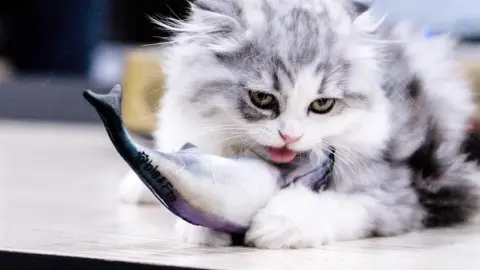
Why Your Cat Stares At You And How To Slow Blink Back
This article is an English translation of the original Japanese article. Read the original Japanese version.
Ever feel your cat’s eyes on you and wonder what they are really saying. Learn what slow blinking means, when a steady gaze signals trust or tension, and how to respond in ways that strengthen your bond instead of stressing your cat.
Key takeaways
Q. How should I correctly respond when my cat gives me a slow blink?
Turn your body slightly sideways, soften your gaze, slowly blink over about 3 seconds, then gently avert your eyes a little.
Q. In what situations should I avoid staring back at my cat?
Avoid staring back when pupils are dilated in tension, during hunting play, while guarding food or territory, right after environmental changes or first contact, and when there is rivalry in multi-cat homes.
Q. Are there common mistakes and cautions when doing a slow blink?
Avoid blinking too fast, touching your cat immediately afterward, or leaning in head-on, and be cautious that one narrowed eye or tearing may indicate a health issue.
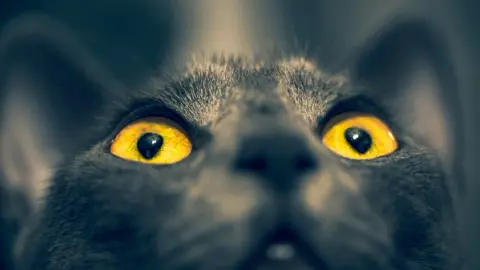
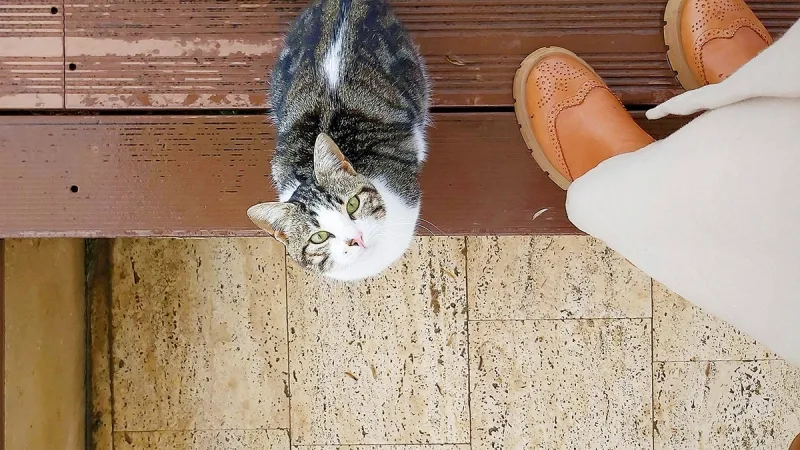
In homes around the world, Pet Parents often notice the same quiet moment. You look up from your phone or your coffee, and your cat is just sitting there, staring at you. That steady gaze can feel intense, but behind those eyes is a rich mix of emotion and communication.
One of the most fascinating of these signals is the slow blink. This is not just a lazy eyelid droop or a random blink. Feline behavior experts widely recognize the slow blink as a sign of affection, trust, and emotional safety.
In this guide, you will learn what slow blinking really means, how to return it correctly, and when it is actually kinder not to stare back.
Five Common Reasons Your Cat Stares At You
When your cat fixes their eyes on you, there is rarely a single explanation. Context matters. The surrounding environment, your recent actions, and your cat’s body language all shape what that gaze means.
Below are five of the most common reasons cats stare at their Pet Guardians and how to interpret each one.
Slow Blinking To Show Affection And Safety
When your cat looks at you and slowly closes and opens their eyes, that is the classic slow blink. In feline social behavior, a slow blink is a clear message of “I trust you” and “I do not mean any harm.”
Among cats, a hard, unbroken stare with wide eyes can be a challenge or a threat. Predators and rivals watch each other closely, and direct eye contact can escalate tension. By contrast, deliberately relaxing the eyelids and blinking slowly is like lowering their guard in your presence.
When your cat offers you a slow blink, they are essentially saying, “I feel safe enough with you to let my defenses down.” Responding with your own gentle slow blink can reinforce that sense of security and deepen your bond.
Asking For Food, Play, Or Attention
Not every stare is a love letter. Sometimes, your cat is simply trying to get what they want.
If your cat sits near the kitchen, food storage area, or their feeding station and stares at you, they may be signaling, “You forgot something.” In these moments, you might also notice bright, focused eyes, a gently swishing tail, or soft meows layered on top of the gaze.
In many homes, cats learn that looking at their Pet Parent is an effective way to request:
- Meals or treats when it is close to their usual feeding time
- Interactive play when they are bored or under-stimulated
- Social contact such as petting, brushing, or simply sitting nearby
If this pattern repeats around the same times each day, consider whether your cat’s schedule, enrichment, or feeding routine needs a small adjustment.
Carefully Watching Your Routine
Cats are exceptional observers. Over time, they build a mental map of your daily habits and the sounds and movements that predict important events.
You may notice your cat staring when you open a door, reach for a particular cabinet, or head toward the refrigerator. They are not just being nosy. They are actively learning cause and effect, such as “When this door opens, my Pet Guardian often brings out treats” or “That sound means dinner is coming.”
In these moments, your cat’s gaze is a mix of curiosity and quiet calculation. Staring is one of their main tools for gathering information about their environment and the humans who share it.
Feeling Anxious Or On High Alert
Sometimes a stare is not about affection or curiosity at all. It can be a sign that your cat is worried.
When a cat’s eyes are wide open and the pupils are noticeably dilated, especially in bright light, this often indicates heightened arousal, fear, or vigilance. You may also see other signs of tension, such as:
- Ears flattened or angled back
- Whiskers pushed forward
- Body held low or stiff
- Tail puffed or tightly wrapped around the body
In this state, returning a strong, direct stare can be misread as a challenge or threat. Instead, it is usually kinder to soften your gaze, look slightly away, and give your cat more physical space. This helps communicate that you are not a danger and allows them to calm down at their own pace.
Trusting You Enough To Meet Your Eyes
In the wild, many animals avoid direct eye contact because it can signal confrontation. Cats are no exception. A cat that does not fully trust someone will often look away, keep their distance, or position themselves where they can watch without being seen.
When your cat chooses to meet your eyes calmly, especially in a relaxed environment, it is a meaningful sign. Being able to hold your gaze without tension suggests your cat feels secure and believes you will not harm or challenge them.
This quiet confidence is one of the most rewarding parts of living with a cat. It reflects the history of gentle handling, predictable routines, and respectful interactions you have built together.
How To Return Your Cat’s Slow Blink The Right Way
Receiving a slow blink from your cat is an honor. Responding thoughtfully can turn it into a powerful daily ritual that strengthens your relationship.
The goal is to mirror your cat’s calm, non-threatening body language. The following steps can help you send a clear, reassuring message back.
Start With A Relaxed, Non-Threatening Posture
Before you focus on your eyes, check how you are holding your body. Cats are sensitive to posture and movement.
Whenever possible, position yourself so that your body is slightly angled rather than squared up directly toward your cat. Avoid looming over them or leaning in too close. Experts often recommend keeping a comfortable distance of about three to six feet (around one to two meters), especially with more cautious cats.
If your cat is on the floor or a lower surface, gently lower yourself by sitting or kneeling so you are not towering above them. The aim is to look approachable, not imposing.
Soften Your Gaze
A successful slow blink starts with relaxed eyes. Instead of opening your eyes wide, consciously release tension in your forehead, eyebrows, and eyelids.
Try to look not at a single sharp point in your cat’s eye, but at the soft area between their eyes or just below them. This creates a gentle, unfocused gaze. Think of it less as “staring at” your cat and more as “quietly watching over” them.
This subtle shift helps your cat read your expression as calm and friendly rather than intense or confrontational.
Close And Open Your Eyes Slowly
Timing matters. A rushed blink can look more like a flinch than a friendly signal.
Many behavior specialists suggest using a simple three-second rhythm:
- Take about one second to slowly close your eyes.
- Keep your eyes softly closed for about one second.
- Take another second to gently open your eyes again.
After you open your eyes, let your gaze drift slightly to the side instead of locking back onto your cat’s pupils. This small glance away reinforces the message “I am relaxed and not a threat.”
You can repeat this once or twice, then return to whatever you were doing. If your cat feels comfortable, they may respond with their own slow blink or simply remain calmly in place.
Let Your Face And Body Move Naturally
If you only move your eyelids and keep the rest of your face frozen, the gesture can feel stiff or unnatural.
As you complete the slow blink, allow a tiny, relaxed change in your expression. You might:
- Let your head tilt slightly as your eyes reopen
- Soften your mouth or let the corners of your lips lift just a touch
- Loosen your shoulders so your whole posture looks at ease
These subtle movements help your cat read your entire body as calm and friendly, not just your eyes.
Pause Before Reaching Out
It can be tempting to immediately reach for your cat after a sweet slow blink exchange. However, moving too quickly from a calm eye signal to physical contact can sometimes startle a sensitive cat or shift them back into a more alert state.
Instead, give the moment a brief, quiet ending. Take one or two gentle breaths before you speak, stand up, or offer your hand. If your cat chooses to approach you after that pause, you can respond with petting or play on their terms.
When You Should Not Stare Back At Your Cat
Not every feline gaze is an invitation to connect. In some situations, returning a direct stare can increase stress or even escalate tension.
Learning to recognize these moments allows you to respond in a way that protects your cat’s emotional comfort.
When Your Cat Is Very Tense Or On Guard
If your cat’s pupils are large, their ears are pinned back, and their whiskers are thrust forward, they are likely in a heightened state of alert. Their body may be rigid, and their tail may be puffed or lashing.
In this condition, a firm, direct stare from a human can be interpreted as a challenge. Instead of slow blinking repeatedly, consider a softer approach:
- Offer a single, gentle blink from the corner of your eye
- Keep your head slightly turned so you are not facing them straight on
- Then calmly look away and give them more space
This combination signals that you see them, respect their discomfort, and are not trying to push closer.
When Their Hunting Instincts Are Fully Engaged
During active play, especially with toys that mimic prey, your cat’s focus narrows. Their eyes may lock onto the moving object, and their body may crouch, wiggle, and then spring into motion.
If you try to catch their eye and slow blink in the middle of this “hunting mode,” you may accidentally add to their arousal instead of calming them. In some cases, they might redirect that energy toward your hands or feet.
In these moments, it is usually more effective to:
- Gently slow the toy and bring the play session to a natural pause
- Allow your cat to “catch” the toy a few times to satisfy their hunting sequence
- Then transition to a calmer interaction, such as petting or a slow blink, once their energy has come down
When They Are Guarding Food Or A Favorite Spot
Many cats feel strongly about certain resources, such as their food bowl, litter box, or a high perch like the top of a cat tree. While not all cats are territorial, some may become protective in these areas.
If your cat is eating, using the litter box, or resting in a prized location and glances your way, holding their gaze too long can feel intrusive. Instead, it is often kinder to:
- Briefly acknowledge them with a soft look or single blink
- Then deliberately look away and give them physical space
This approach reassures your cat that you respect their boundaries and are not competing for their resources.
During First Meetings Or Right After Big Changes
New environments and major changes can be overwhelming for cats. Adoption, moving homes, renovations, or the arrival of new people or animals can all raise stress levels.
In these periods, your cat’s priority is to establish a sense of safety. While slow blinking can still be helpful, prolonged, direct eye contact from a new person or in a new space can feel intimidating.
A more supportive strategy is to:
- Sit or stand at a comfortable distance
- Angle your body slightly away
- Offer occasional soft blinks without staring continuously
Let your cat decide when to approach. Over time, as they relax, you can gradually increase gentle eye contact.
When There Is Tension Between Multiple Cats
In multi-cat households, social dynamics can be complex. If two cats are already sizing each other up, your attention can unintentionally tip the balance.
If you focus your gaze and affection on only one cat while another is watching, the overlooked cat may feel excluded or more insecure. In some situations, this can add to existing rivalry.
To support harmony, try to:
- Distribute your attention and slow blinks as evenly as possible
- Avoid staring at one cat while another is clearly tense or watching closely
- Provide multiple resources (bowls, litter boxes, resting spots) so no one feels they must compete
Common Slow Blink Mistakes And How To Fix Them
Even with the best intentions, it is easy to send mixed signals at first. The good news is that cats are remarkably forgiving when we are trying to communicate kindly.
Here are some frequent slow blink missteps and simple ways to adjust:
-
Blinking too quickly
If your eyelids snap shut and open in a fraction of a second, it can look more like a startle than a calm signal. Practice counting to three in your head to keep the motion slow and smooth. -
Reaching out immediately after blinking
Jumping straight from a slow blink to petting can surprise some cats. Try adding a brief pause of one or two breaths before you move your hand. -
Leaning in and staring from directly in front
Getting too close or bending over your cat while you blink can feel overwhelming. Instead, lower your body gently and keep a bit of distance, with your torso slightly angled. -
Ignoring signs of eye discomfort
Not every narrowed eye is a slow blink. If your cat frequently squints with one eye, has visible discharge, or shows the third eyelid (a whitish or pinkish membrane at the inner corner), this may indicate irritation, injury, or illness. In those cases, schedule a prompt checkup with your veterinarian rather than assuming it is a friendly signal.
By paying attention to both your cat’s response and their overall body language, you can fine-tune your slow blink so it consistently reads as calm and reassuring.
Bringing Slow Blinks Into Everyday Life
The slow blink is a simple, powerful way to tell your cat “You are safe with me” in a language they naturally understand. It takes only a few seconds, requires no special tools, and can be woven into your daily routine with ease.
Try incorporating slow blinks during quiet, low-stress moments, such as before bed, while you are relaxing on the sofa, or when your cat is resting in a favorite spot. Over time, many cats begin to offer slow blinks first, turning it into a shared ritual.
By learning why your cat stares, recognizing when to return their gaze, and understanding when to gently look away, you become a more fluent partner in their world. Every soft blink, respectful pause, and calm response helps build a deeper, more trusting connection.
As you move through daily life together, keep listening to what your cat’s eyes are telling you. In those quiet moments of shared understanding, you are building a lifetime of trust.
- 03.20.2026
- 10.13.2025