Raccoon Dog Or Masked Mystery Guest How To Recognize Japanese Civets And Why They Do Not Make Good Pets

This article is an English translation of the original Japanese article. Read the original Japanese version.
Heard strange footsteps in the attic after dark You might be sharing your neighborhood with a masked palm civet a nocturnal wild animal often confused with martens and badgers. Learn how to tell these lookalikes apart and why experts strongly advise against keeping civets as pets.
What Exactly Is A Japanese Civet
The animal many people in Japan call hakubishin is the masked palm civet Paguma larvata a small to medium sized mammal in the order Carnivora and the civet family. Despite the cat like face it is not a true cat and is genetically closer to mongooses.
Masked palm civets are native to southern China and parts of Southeast Asia but they have also become established across much of Japan including Honshu Shikoku and Kyushu. Historical records suggest they were introduced centuries ago and over time they have adapted so well that they now behave much like a naturalized native species.
Adult civets typically measure about 50 to 70 centimeters in body length with a tail that adds another 40 to 60 centimeters. That long tail almost as long as the body is one of the easiest ways to recognize them. On the face you will see a distinct white stripe running from the nose up the forehead. This striking mark is the origin of the Japanese name hakubishin literally white nose stripe.
Civets are omnivores with a very flexible diet. In the wild they eat fruits insects and small animals and in human dominated areas they may raid crops or even rummage through household garbage. They are excellent climbers and can move easily along branches power lines and roof beams which is why they sometimes end up living in attics and ceiling spaces.
As strictly nocturnal animals civets rest during the day in trees or hidden spaces such as attics then become active after dark. If you hear light but rapid footsteps or thumping across the roof late at night there is a chance a civet is using your home as a nighttime highway.
What Makes A Civet Different From A Typical Cat
Although the face may look cat like civets belong to a different branch of the carnivore family tree. They are more closely related to mongooses and other small carnivores than to domestic cats.
Many civet species have well developed scent glands near the anus that produce a strong musky odor. Historically this secretion known as musk was used in high end perfumes. Modern perfumery relies far less on animal derived musk but the association with strong scent remains an important part of civet biology and behavior.
Telling Civets Martens And Badgers Apart
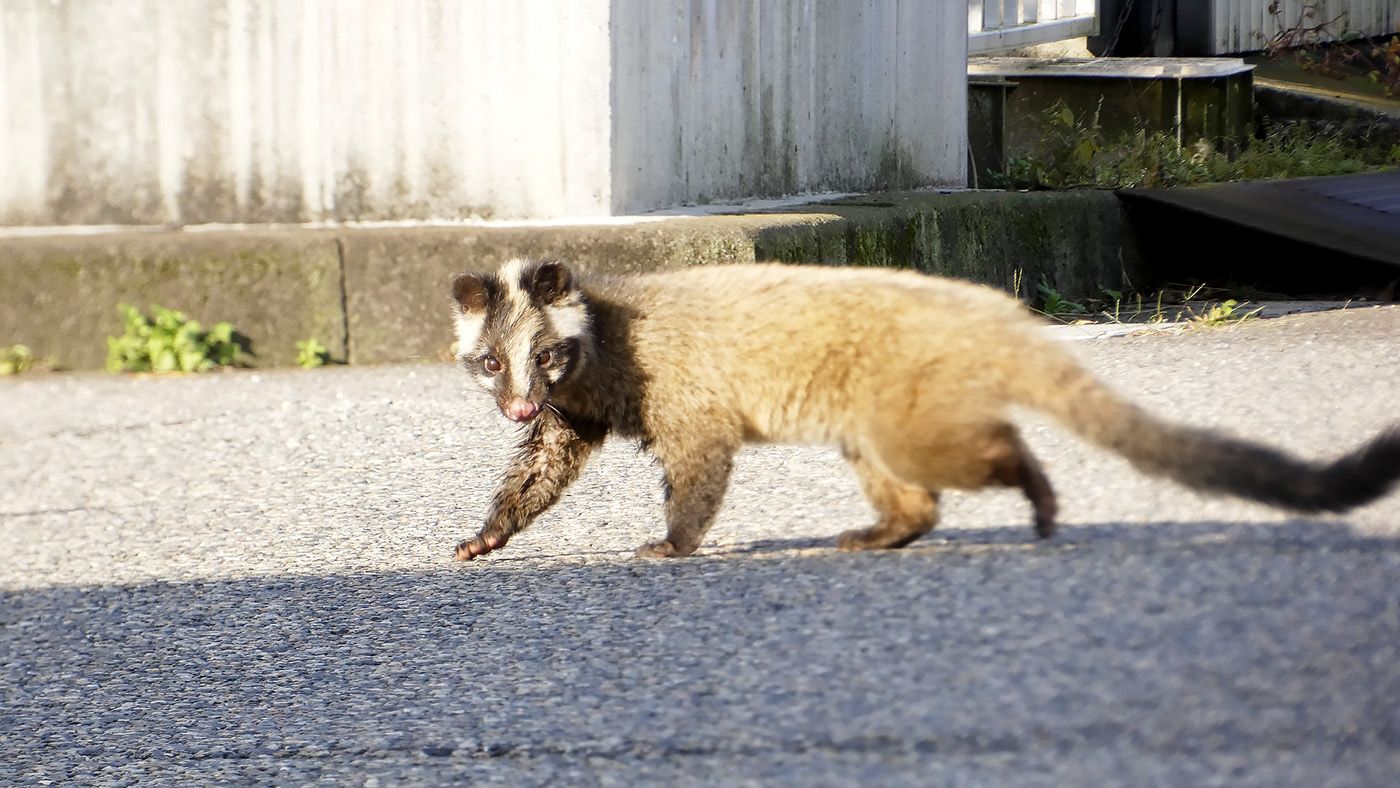
In Japan pet parents and homeowners often confuse civets with two other wild mammals the marten ten and the Japanese badger anaguma. At a quick glance all three can look similar especially at night or from a distance.
Learning a few simple visual cues can help you identify which animal you are seeing.
Civet Versus Marten

Martens are members of the weasel family closely related to sables and other mustelids. In Japan they are typically forest dwellers and are much less likely than civets to show up in dense urban neighborhoods.
Their coat changes with the seasons. In summer martens are usually a warm brown while in winter their fur becomes more yellowish with a creamy patch around the throat and chest. Unlike civets martens do not have a sharp white stripe down the center of the face. Their faces tend to look rounder and softer in outline.
Martens are also a bit smaller and more slender than civets and they move with quick agile motions. Encounters are most common in mountain forests and wooded areas rather than in city centers.
Civet Versus Japanese Badger

Japanese badgers have a stocky barrel shaped body built for digging. They are ground dwelling animals that specialize in excavating burrows and tunnels in soil.
On the face badgers show a pattern of dark fur around the eyes with paler fur along the center of the face. However this pale area is not a single clean white line like the civet stripe. Instead it looks more like a broad lighter band framed by darker patches.
Badgers are poor climbers compared with civets. Their lifestyle is focused on the ground and underground so they rarely if ever appear in attics or on rooftops.
Quick Field Guide To Tell Them Apart
When you only get a brief look it helps to focus on a few key features
- White facial stripe A clear single white line from nose up the forehead strongly suggests a civet
- Tail length If the tail looks almost as long as the body you are likely looking at a civet
- Body shape and color Martens are smaller more slender and often yellowish especially in winter while badgers are short legged and chunky
- Lifestyle clues Civets climb and may use roofs and attics martens stay mostly in forests and badgers spend their time digging and living in burrows
Where Civets Martens And Badgers Live In Japan
Although these three species can look similar their distribution and preferred habitats in Japan are not identical.
- Masked palm civet
- Widely found across Honshu Shikoku and Kyushu
- Highly adaptable and can live in rural areas suburbs and even city centers often using attics or roof spaces
- Marten
- Also present on Honshu Shikoku and Kyushu
- Primarily associated with mountain forests and wooded landscapes and rarely seen in busy urban streets
- Japanese badger
- Distributed across Honshu Shikoku and Kyushu
- Favors satoyama style countryside and farming villages where it can dig extensive burrow systems
In Hokkaido none of these three species are considered native residents. Occasional sightings there are usually linked to escaped or released captive animals rather than established wild populations.
Can A Civet Be Kept As A Pet
At first glance civets can look charming with their big eyes and masked faces. However veterinary and wildlife experts strongly advise against keeping civets as pets. There are several important reasons for this recommendation.
Legal Restrictions
In Japan civets are protected under national wildlife protection and management laws. Capturing or keeping a civet without explicit permission from the relevant local authorities is illegal.
Even when permits exist they are typically granted for research rehabilitation or licensed facilities not for private pet guardianship. Pet parents considering unusual or exotic animals should always check current regulations before making any decisions.
Behavior And Lifestyle Challenges
Civets are naturally nocturnal and highly active at night. In a home environment this means they may run jump and climb while human family members are trying to sleep.
They also have strong territorial instincts. To mark their territory civets can produce a powerful musky scent from their glands. In a confined indoor space this odor can quickly become overwhelming and very difficult to remove from fabrics walls and furniture.
House training a civet is extremely challenging. Scratching chewing and destructive exploration are common because these animals are adapted to climbing trees and navigating complex natural environments not living in a typical apartment or house.
Health And Hygiene Concerns
Wild civets often carry fleas ticks and internal parasites. Without proper quarantine and veterinary care these can spread to humans and other pets in the household.
There is also a risk of zoonotic diseases illnesses that can pass from animals to people. Because civets are not domesticated they are less tolerant of handling and may bite or scratch when stressed or frightened increasing the risk of injury and infection.
Taken together the legal behavioral and health issues make civets unsuitable for life as household companions. Responsible pet guardianship means choosing species that can thrive safely and humanely in a home environment.
Appreciating Civets As Wild Neighbors
Civets are fascinating wild animals that have adapted to live surprisingly close to human communities. Their secretive nocturnal habits and masked faces give them a mysterious charm but that same wild nature is exactly what makes them poor candidates for pets.
When you encounter a civet the most respectful approach is to observe quietly from a distance. Avoid chasing cornering or attempting to capture it. If a civet is causing damage or has taken up residence in your attic consult local wildlife authorities or licensed pest control professionals who can recommend humane management options.
By recognizing civets martens and badgers correctly and understanding their needs we can move toward coexisting more thoughtfully with the wildlife around us. For pet parents this means focusing on the health and happiness of truly domesticated companions while leaving wild species like civets to live out their lives in the habitats where they belong.
- 03.03.2026
- 07.23.2025