Discover Carnivorous Plants And Their Hidden World Of Traps And Beauty
This article is an English translation of the original Japanese article. Read the original Japanese version.
Most plants quietly sip sunlight, water, and nutrients from the soil. Carnivorous plants do all that and still hunt for their meals, using ingenious traps and dazzling colors that fascinate plant lovers and nature enthusiasts around the world.
Key takeaways
Q. How does the Venus flytrap capture and digest its prey?
When prey touches its trigger hairs, the trap snaps shut in about 0.3 seconds and digests it over several days.
Q. How is the pitcher plant different from other tubular carnivorous plants?
It has hanging pitcher-shaped traps filled with sweet digestive fluid, and some species can even capture small animals.
Q. What should I be careful about when growing carnivorous plants?
Many come from special habitats like wetlands or highlands; for Venus flytraps, careful humidity control makes cultivation somewhat difficult.
Most plants survive perfectly well on sunlight, water, and nutrients from the soil. Carnivorous plants, however, have evolved in nutrient-poor environments where they need an extra boost, so they supplement their diet by capturing insects and other tiny animals.
These plants are not “monsters” but highly specialized survivors. They still photosynthesize like other plants, yet they have developed remarkable traps, lures, and digestive strategies that continue to intrigue botanists and hobbyists alike.
In this guide, you will meet some of the most iconic and lesser-known carnivorous plants, learn how their traps work, and discover what makes them so appealing to grow and observe.
Venus Flytrap Dionaea muscipula
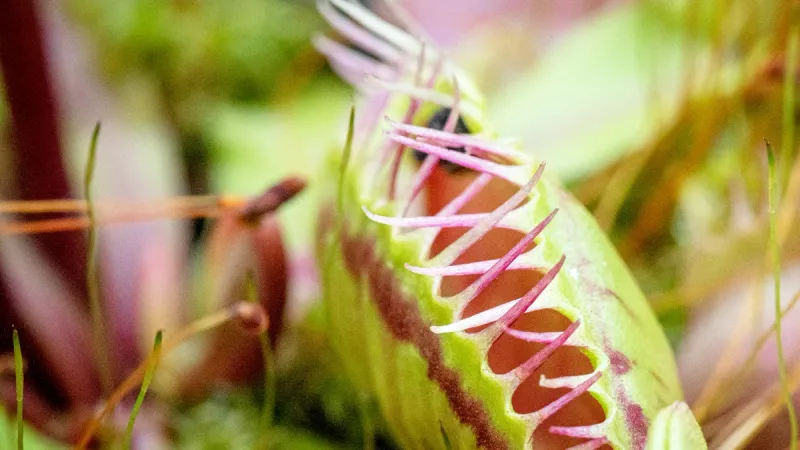
The Venus flytrap is the celebrity of the carnivorous plant world. Its leaves are shaped like a clam shell, lined with sensitive trigger hairs. When an unsuspecting insect touches these hairs twice in quick succession, the trap snaps shut in about 0.3 seconds.
Once the trap closes around its prey, the plant secretes digestive enzymes. Over several days, it absorbs essential nutrients such as nitrogen and phosphorus, then reopens and sheds any indigestible remains like exoskeletons.
In nature, Venus flytraps are native only to limited wetland areas in North and South Carolina in the United States. Habitat loss and overcollection have placed wild populations under pressure, and conservationists are working to protect them.
For plant lovers who want to grow a Venus flytrap at home, experts recommend providing consistently high humidity, bright light, and pure water such as rainwater or distilled water. When these basic needs are met, this dramatic little plant can thrive for years on a windowsill or in a terrarium.
Tropical Pitcher Plants Nepenthes
Nepenthes, often called tropical pitcher plants, are famous for their elegant, vase-shaped pitchers that hang from the ends of their leaves. These pitchers are modified leaves that form deep, fluid-filled traps.
Inside each pitcher, the plant collects a pool of digestive fluid that often has a sweet, attractive scent. Insects lured by the aroma lose their footing on the slippery rim and inner walls, fall into the fluid, and are gradually digested.
Some of the larger Nepenthes species are powerful enough to trap not only insects but also small vertebrates. The species Nepenthes rajah, for example, has been documented capturing small rodents such as larger mice or shrews.
Beyond their hunting skills, Nepenthes are prized as ornamental plants thanks to their striking shapes and wide range of colors, from lime green to deep burgundy. Enthusiasts appreciate them as living sculptures that change and grow over time.
Historically, Indigenous communities in tropical forests are reported to have used the sturdy pitchers as makeshift cups or water containers. Their elongated shape and natural water resistance made them a practical tool in the field.
Butterwort Pinguicula
Butterworts may look delicate, but their hunting strategy is surprisingly effective. Their leaves are flat, often slightly glossy, and coated with a sticky mucilage that acts like natural flypaper.
When small insects land on the leaf surface, they become trapped in the adhesive coating. The leaf then slowly curls or tightens around the prey, and digestive enzymes break down the soft tissues so the plant can absorb valuable nutrients.
True to their name, many Pinguicula species produce small, violet-like flowers in soft pastel shades. This contrast between their gentle blossoms and their carnivorous lifestyle is a major part of their charm for collectors.
Because of their compact size and attractive blooms, butterworts are popular among indoor plant enthusiasts. Consider placing them near windows where small gnats are common; many hobbyists appreciate that these plants can help reduce tiny flying insects around other houseplants.
Sundew Drosera
Sundews are among the most visually striking carnivorous plants. Their narrow leaves are covered in fine tentacles tipped with glistening droplets of sticky mucilage. In sunlight, these droplets sparkle like tiny beads of dew.
When an insect lands on a sundew leaf, it becomes entangled in the sticky secretion. As the prey struggles, it stimulates neighboring tentacles, which slowly bend toward the insect and wrap around it, increasing the number of contact points and making escape nearly impossible.
Historically, the shimmering mucilage of some European sundew species was used in traditional remedies to soothe sore throats and respiratory discomfort. Because of this, sundews were sometimes poetically called the “dew of the sun.”
Today, sundews are widely cultivated and come in many forms, from small rosettes to tall, upright species. They are often recommended as a good entry point into carnivorous plant care because many species adapt well to indoor or greenhouse conditions when given bright light and consistently moist, acidic soil.
North American Pitcher Plants Sarracenia
Sarracenia, commonly known as North American pitcher plants, also rely on tubular traps, but their growth habit differs from Nepenthes. Instead of hanging pitchers, Sarracenia produces upright, tubular leaves that rise directly from the ground or from a central rhizome.
Each tube partially fills with digestive fluid. Insects are attracted by color patterns, nectar, and sometimes scent, then slip down the smooth inner walls. Downward-pointing hairs and the shape of the tube make climbing back out extremely difficult.
Unlike many Nepenthes, the lids of Sarracenia pitchers usually do not close tightly. Instead, they act more like rain shields and visual lures, helping guide insects toward the opening while still allowing light to enter the tube.
Gardeners in suitable climates often grow Sarracenia outdoors in bog gardens or containers. Experts recommend providing full sun, consistently wet, low-nutrient soil, and winter dormancy to keep these plants vigorous year after year.
Heliamphora The Sun Pitcher Plants
Heliamphora, sometimes called sun pitcher plants, are rarer in cultivation and highly sought after by dedicated carnivorous plant enthusiasts. Their leaves form upright, tubular pitchers similar to Sarracenia, but their hunting strategy has a unique twist.
Unlike many other pitcher plants, Heliamphora species do not produce large amounts of their own digestive fluid. Instead, their pitchers often collect rainwater in their natural highland habitats. Insects that fall in can drown in this water, after which the plant relies on a combination of mild secretions and microbial activity to break down the prey.
Heliamphora are native to cool, misty highlands in parts of South America, including tepui plateaus. They are adapted to bright light, high humidity, and relatively cool temperatures, which can make them more challenging to grow in typical home environments.
Experienced growers suggest that anyone interested in Heliamphora focus on creating stable conditions with strong, indirect light, excellent air circulation, and cool nights. With the right setup, these plants reward their caretakers with elegant, sculptural pitchers that look almost otherworldly.
Welcoming Carnivorous Plants Into Your World
From the lightning-fast snap of the Venus flytrap to the elegant pitchers of Nepenthes and Sarracenia, carnivorous plants showcase a remarkable range of survival strategies. Some rely on rapid movement, others on clever traps, and still others on simple but powerful sticky leaves.
Beyond their hunting abilities, these plants offer a unique aesthetic appeal. Their unusual shapes, vivid colors, and mysterious lifestyles make them conversation starters in any collection, whether you are a seasoned plant enthusiast or just beginning to explore the world of specialty plants.
Many carnivorous species come from wetlands, bogs, or cool highlands, so their care requirements can be more specialized than those of common houseplants. Consider researching the natural habitat of each species you bring home and aim to recreate key elements such as moisture level, light intensity, and seasonal temperature changes.
If you are already a pet parent or pet guardian, carnivorous plants can be a fascinating, low-interaction addition to your living space, as long as you keep them out of reach of curious paws and beaks. With thoughtful care and respect for their unique needs, you can enjoy these extraordinary plant-animal hybrids of the botanical world and deepen your appreciation for how life adapts to even the harshest environments.
- 03.20.2026
- 03.27.2025