The True Story of Hachiko The Loyal Akita Who Waited a Lifetime
This article is an English translation of the original Japanese article. Read the original Japanese version.
Hachiko is more than a famous statue outside Shibuya Station. Discover the real dog behind the legend, his unbreakable bond with Professor Hidesaburo Ueno, and how war, loss, and rebuilding turned one Akita into a global symbol of loyalty.
Hachiko The Akita Who Captured Japan’s Heart
Hachiko is now one of Tokyo’s most recognizable icons, but the real dog behind the statue had a life story far richer than a simple legend. His tale weaves together the history of modern Japan, the evolution of the human–dog bond, and the resilience of people rebuilding after war.
In this guide, you will meet Hachiko the dog, Professor Hidesaburo Ueno, and the five Hachiko statues that keep their story alive across Japan.
An Akita Puppy Named Hachi
Hachiko was born in early November 1923 in Odate City, Akita Prefecture, in northern Japan. He was an Akita, a large, powerful Japanese breed traditionally valued as a hunting and guard dog.
At first, he was simply called Hachi, a common name meaning “eight,” which is considered a lucky number in Japan. Only later, after his devotion became widely known, did people begin to call him “Chuken Hachiko” or “Hachiko the Faithful Dog.”
Akitas are known for their strong loyalty, calm dignity, and close attachment to their families. Accounts from the time suggest that Hachi showed these classic Akita traits early on, forming a deep emotional bond with his guardian, Professor Ueno.
Professor Hidesaburo Ueno The Scholar Behind the Legend
Hachi’s guardian, Professor Hidesaburo Ueno, was a respected academic at the Faculty of Agriculture at Tokyo Imperial University, known today as the University of Tokyo.
He was a pioneering figure in Japanese agricultural civil engineering, focusing on irrigation, drainage, and improving rural environments. In 1922, two years before Hachi came into his life, Professor Ueno received the Order of the Sacred Treasure, Gold Rays with Neck Ribbon, a national honor recognizing his contributions.
Former students described him as gentle, patient, and deeply committed to teaching. His reputation as both a serious researcher and a caring mentor helps explain why his relationship with Hachi resonated so strongly with the public.
A Life-Changing Meeting Between Professor and Puppy
Hachi joined Professor Ueno’s household in January 1924, when he was about two months old. A former student introduced the Akita puppy to the professor, who decided to bring him home, paying 30 yen.
To understand that decision, consider that 30 yen at the time would be roughly equivalent to 75,000–80,000 yen today (several hundred US dollars). This was not an impulse purchase; it was a thoughtful commitment to a specific dog and breed.
Hachi was raised with care by Professor Ueno and his partner, Yaeko Sakai. Before long, their daily routine developed into the ritual that would make Hachiko famous.
The Daily Walk To Shibuya Station
The Ueno residence stood in what is now Shoto 1-chome in Shibuya Ward, near today’s Bunkamura cultural complex. From there, it took about ten minutes on foot to reach Shibuya Station.
Each morning, Professor Ueno walked to the station with Hachi at his side. In the evening, Hachi would wait by the ticket gate for his guardian’s return. After seeing the professor off, Hachi reportedly walked home alone, then made his way back to the station at the expected return time.
For modern pet parents, the idea of a dog navigating city streets alone feels unthinkable. At that time, however, free-roaming dogs were more common, and Hachi’s intelligence and routine allowed him to move safely between home and station.
Sudden Loss Professor Ueno’s Death
In May 1925, just before Hachi’s second birthday, tragedy struck. While giving a lecture, Professor Ueno collapsed and died suddenly.
Overnight, Hachi lost the person at the center of his world. Yet his routine did not end. He continued to appear at Shibuya Station, waiting for a guardian who would never again step off the train.
A New Home With the Gardener Who Understood Him
After the professor’s death, Hachi’s care passed to Kikusaburo Kobayashi, a gardener who had long worked for the Ueno household.
Kobayashi lived in the Shibuya–Yoyogi area, still within walking distance of Shibuya Station. This made it possible for Hachi to continue his daily visits. Under Kobayashi’s care, Hachi had food, shelter, and safety, yet he still chose to return to the station again and again.
As commuters and station staff noticed the dog who waited every day, local newspapers began to report on his story. The image of an Akita faithfully returning to the same spot for years after his guardian’s death moved readers across Japan.
Hachiko’s Final Years and Passing
Nearly ten years after Professor Ueno’s death, on March 8, 1935, Hachi died near Shibuya Station at the age of 11.
News of his passing appeared on the front page of major newspapers the next day. Across the country, people mourned not just a dog, but a symbol of unwavering loyalty and love.
Today, Hachiko’s taxidermied body is preserved and displayed at the National Museum of Nature and Science in Ueno, Tokyo, where visitors can see what he truly looked like and learn more about his life.
The First Hachiko Statue A Landmark Is Born
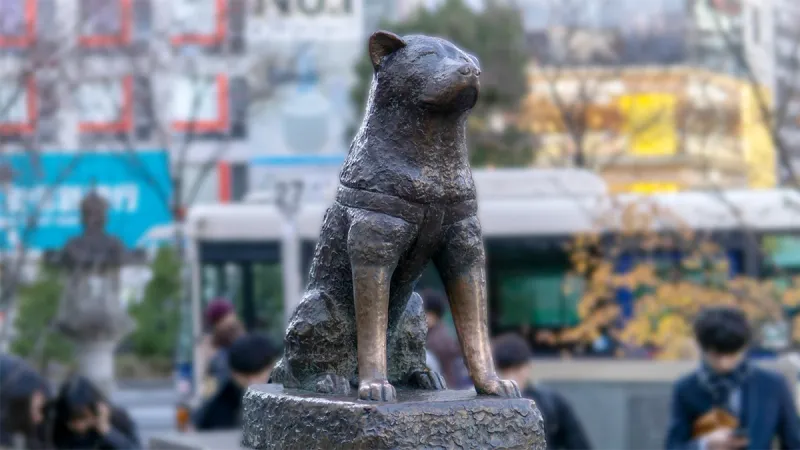
To honor Hachiko while he was still alive, supporters commissioned a bronze statue to be placed in front of Shibuya Station. In 1934, the first Hachiko statue was unveiled.
The sculptor, Teru Ando, created a seated Akita figure that captured Hachi’s calm, watchful presence. Historical accounts say that Hachi himself attended the unveiling ceremony, standing near the statue that would immortalize him.
The statue quickly became a beloved meeting spot and a symbol of Shibuya. However, the outbreak of war would soon change its fate.
War, Metal Collection, and Loss
In 1944, during World War II, Japan enforced strict metal collection policies to support the war effort. The original Hachiko statue was removed and melted down in Hamamatsu, reportedly to be used for locomotive parts.
For many people, the loss of the statue represented more than just the removal of a landmark. It symbolized how war can strip away everyday sources of comfort, memory, and community.
Rebirth After the War The Second Hachiko Statue
After the war, there was a strong desire to restore Hachiko’s presence at Shibuya Station. Teru Ando’s son, Takeshi Ando, took on the task of creating a new statue.
In 1948, the second Hachiko statue was unveiled in front of Shibuya Station, where it still stands today. Because the original had been destroyed, the new statue is not an exact copy. Instead, Takeshi drew on his father’s style and his own interpretation of Hachiko’s character.
Postwar Japan faced severe material shortages, and even bronze was difficult to obtain. According to accounts, Takeshi melted down one of his father’s earlier works, a sculpture titled To the Skies, to secure enough metal for the new Hachiko statue. In this way, the legacy of father and son, and of Hachiko himself, became physically intertwined.
Hachiko as a Global Symbol of Loyalty
Over time, Hachiko has come to represent far more than a single dog’s devotion. He is widely seen as a symbol of a dog’s enduring love and loyalty toward their guardian.
The Shibuya statue remains one of Tokyo’s most popular meeting points. Tourists and locals alike pose for photos, often without knowing the full depth of the story behind the bronze figure.
Beyond Shibuya, Hachiko is also honored in his birthplace of Odate City, where additional statues and memorials celebrate his life and the Akita breed.
The Five Main Hachiko Statues You Can Visit
Many people know the famous statue at Shibuya Station, but there are several other Hachiko statues across Japan that highlight different moments and relationships in his life.
Here are the key locations where Hachiko is commemorated:
-
Shibuya Station Hachiko Statue Tokyo
The best-known statue sits outside the Hachiko Exit of Shibuya Station. This is the classic seated pose that has become a global symbol of loyalty and a favorite meeting spot. -
Professor Ueno and Hachiko Statue University of Tokyo Faculty of Agriculture
On the University of Tokyo’s agricultural campus, you will find a heartwarming statue of Hachiko joyfully leaping up to greet Professor Ueno. This piece emphasizes their emotional reunion and the bond between guardian and dog. -
Professor Ueno and Hachiko Statue Hisai Station Mie Prefecture
In Hisai Motomachi, Mie Prefecture, near Hisai Station, another statue of Professor Ueno and Hachiko stands in the professor’s hometown. Here, Hachiko appears lively and energetic, as if the professor is speaking gently to him. -
Hachiko Statues in Odate City Akita Prefecture
Hachiko’s birthplace, Odate City, is home to three additional statues that reflect different stages of his life:-
Odate Station Hachiko Statue
Located in Odate’s Onarimachi district, this statue shows Hachiko in a seated pose similar to the Shibuya version, honoring him as a faithful Akita from this region. -
Hachiko Statue of Longing for Home Akita Dog Museum
In front of the Akita Dog Museum in Sannomaru, Odate, a standing four-legged Hachiko looks as if he is gazing into the distance. The pose suggests a dog longing for home and the people he loves. -
Puppy Hachiko Statue at His Birthplace
At the site of Hachiko’s birthplace in Daigochi, Odate, a smaller statue depicts Hachiko as a seated puppy. This memorial celebrates his beginnings and the early life of the dog who would become a legend.
-
These statues, spread across Tokyo, Mie, and Akita, show how deeply Hachiko’s story has entered Japan’s cultural memory.
Hachiko’s Story and the History Around Him
Hachiko’s life is not just a touching dog story. It also reflects broader historical themes:
- The changing relationship between people and dogs in urban Japan
- The rise of modern transportation and daily commuting
- The destruction caused by war, including the loss of public art
- The determination to rebuild and remember after conflict
By looking closely at Hachiko’s story, pet parents and history lovers alike can better understand how animals and humans shape each other’s lives, even in difficult times.
Carrying Hachiko’s Legacy Into Your Relationship With Your Dog
Hachiko’s devotion to Professor Ueno continues to inspire people around the world. While most pet parents will never experience a story as dramatic as Hachiko’s, his life offers meaningful reminders.
Consider how you can honor your own dog’s loyalty in everyday ways:
- Build predictable routines so your dog can feel secure, just as Hachiko relied on his daily walks to the station.
- Show consistent affection and clear communication, helping your dog understand that they are a valued member of the family.
- Learn about your dog’s breed traits and needs, as understanding Akita characteristics helps explain Hachiko’s behavior.
Hachiko’s bronze statues may stand still, but the values they represent are very much alive. By deepening the bond with your own dog, you carry forward a small part of the loyalty and love that made Hachiko unforgettable.
- 03.02.2026
- 09.28.2025