Why The Japanese Chin Is The Quiet Noble Companion Many Pet Parents Overlook
This article is an English translation of the original Japanese article. Read the original Japanese version.
When people think of Japanese dogs, Shiba and Akita often steal the spotlight. Yet the Japanese Chin, once cherished by nobles and empresses, offers a uniquely calm, catlike charm that makes it an ideal indoor companion for modern pet parents around the world.
In this guide, you will discover the Japanese Chin’s little-known history, how it differs from other Japanese breeds, and why its gentle temperament makes it such a rewarding housemate for today’s pet parents.
Did The Japanese Chin Come From China
Many historians believe the Japanese Chin originally arrived from China before developing into a distinct companion breed in Japan.
Written records suggest that small lapdogs resembling the Chin were already present in Japan by the Nara period. Some sources describe dogs presented from the Korean kingdom of Silla during the reign of Empress Suiko, indicating that these early toy dogs were carefully bred and cherished over many centuries.
By the Edo period, the Chin had become a classic "lap dog" for the shogunate, court nobles, and wealthy townspeople. During the era of Tokugawa Tsunayoshi, animal welfare was strongly promoted, and his famous "Edicts on Compassion for Living Things" encouraged a culture of keeping animals safely indoors.
Within this environment, the Japanese Chin evolved into a refined indoor companion whose role was to stay close, offer quiet company, and embody a uniquely Japanese sense of elegance.
How The Japanese Chin Differs From Other Japanese Dogs
Although the Japanese Chin is widely recognized as a representative Japanese breed, its position is quite different from the so-called "Japanese dogs" that many people know, such as the Shiba Inu or Akita Inu.
In Japan, the term "Japanese dogs" usually refers to six native spitz-type breeds: Shiba Inu, Akita Inu, Kai Ken, Kishu Ken, Shikoku Ken, and Hokkaido Inu. These breeds are designated as natural monuments and were traditionally used for hunting or guarding.
By contrast, the Japanese Chin is classified internationally as a toy companion breed originating from Japan. Major kennel clubs, including the FCI (Fédération Cynologique Internationale) and the AKC (American Kennel Club), register the breed under the name Japanese Chin.
Loading...
In other words, the Japanese Chin is best understood as a "small noble dog shaped by Japanese culture," bred specifically to live indoors and spend calm, close-knit time with people.
The Japanese Chin In Diplomacy From Commodore Perry To Queen Victoria
The Japanese Chin even appears in the history of international diplomacy.
When Commodore Perry arrived in Japan in 1853, several small dogs were sent from Japan to the United States. These dogs were recorded as "Japanese Spaniels" and are now widely regarded as the ancestors of what the world came to know as the Japanese Chin.
Around the same period in the 1850s, a few Chins were also brought from Japan to the United Kingdom. Historical accounts note that one of these dogs was presented to Queen Victoria, who was known for her love of small companion breeds.
In this way, the Japanese Chin became a cultural ambassador of Edo-era refinement, standing alongside ukiyo-e prints and fine crafts as one of Japan’s most charming exports.
The Japanese Chin In Ukiyo-e Art
The presence of the Japanese Chin is also clearly visible in Edo-period visual culture, especially in ukiyo-e woodblock prints.
For example, Katsushika Hokusai’s fan painting "Chin" and the small dogs depicted in Utagawa Kuniyoshi’s "Gyooku no Hazime" show distinctive features strongly associated with the Japanese Chin.
In many prints, Chins appear alongside beautiful women, suggesting that even in the Edo period they were already seen as icons of cuteness and elegance, much like today’s social media-famous toy breeds.
Key Characteristics Of The Japanese Chin
With this historical backdrop in mind, let’s look at what defines the modern Japanese Chin.
Size And Build
The Japanese Chin is a small dog, typically standing about 20–25 cm (8–10 inches) at the shoulder and weighing around 2–4 kg (4–9 pounds).
Despite its compact size, the breed has a surprisingly solid, well-structured frame. The body is close to square in proportion, with a deep chest that supports healthy respiration and a balanced outline.
Coat And Colors
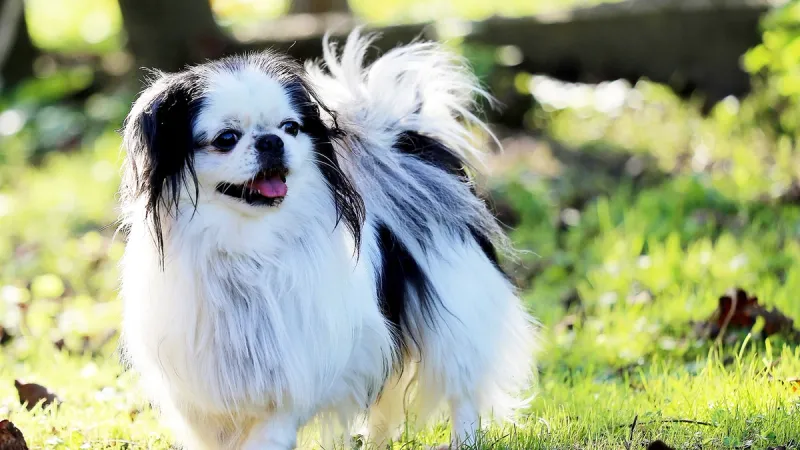
One of the most striking features of the Japanese Chin is its long, silky coat.
The breed has a single coat (single coat type), which tends to tangle less than some double-coated breeds and is relatively straightforward to maintain with regular care. The classic pattern is a white base with black or red patches (including red, sable, or similar shades). Depending on the kennel club, tricolor patterns may also be accepted.
Facial Features
The Japanese Chin is instantly recognizable by its large, round eyes and short muzzle.
Many Chins display a distinctive "chrysanthemum" pattern on the forehead and a white blaze running down the bridge of the nose. These markings are highly prized by many enthusiasts and contribute to the breed’s refined, expressive look.
Temperament And Personality
The Japanese Chin is beloved for its calm, gentle nature and strong desire to stay close to its pet guardians.
They are typically quiet dogs with relatively low levels of nuisance barking. While they may be a bit reserved or cautious when meeting new people, they tend to form deep, loyal bonds once trust is established.
Many pet parents describe the Chin as "catlike" because of its combination of independence, poise, and preference for peaceful companionship rather than constant rough-and-tumble play.
Everyday Living With A Japanese Chin
In terms of exercise needs, the Japanese Chin is generally easy to accommodate.
Most individuals do well with short daily walks and light indoor play, rather than intense physical activity. This makes the breed a strong match for apartment living or quieter households.
The Chin often adapts well to multi-dog homes and can be a good fit for families with small children or older adults, provided that interactions are supervised and gentle handling is taught. Their moderate energy level and affectionate but not overly demanding nature can be especially appealing for pet guardians who value a peaceful home environment.
Health Care And Grooming Tips For Japanese Chin Pet Parents
Overall, the Japanese Chin is considered a relatively healthy and manageable breed. However, like many brachycephalic (short-nosed) dogs, they can be sensitive to heat and humidity.
During warmer months, experts recommend:
- Maintaining a cool indoor environment, ideally with air conditioning
- Avoiding vigorous exercise, especially in the heat of the day
- Monitoring breathing closely during walks or play
Because the Chin’s eyes are large and somewhat prominent, they are more vulnerable to dryness, irritation, and minor injuries from dust or debris.
Pet guardians should consider:
- Gently wiping the face and eye area daily with a soft, damp cloth
- Consulting a veterinarian promptly if there is redness, discharge, squinting, or frequent pawing at the eyes
Like many small breeds, the Japanese Chin can also be predisposed to issues such as patellar luxation (slipping kneecaps) and tracheal collapse.
To help reduce risk and protect joint and airway health:
- Use non-slip mats or rugs on slippery floors such as hardwood or laminate
- Avoid excessive jumping from high furniture
- Use a harness instead of a collar for walks to reduce pressure on the trachea
For grooming, most experts recommend brushing the coat one to two times per week.
Pay special attention to areas where tangles are more likely to form, such as behind the ears, around the neck, and around the legs and tail. A monthly bath is usually sufficient for most Chins, though some may benefit from more frequent partial grooming or spot cleaning depending on lifestyle.
Regular nail trims, ear checks, and dental care (including toothbrushing) should be part of the routine to support long-term health.
How The Japanese Chin Compares To Other Japanese Breeds
Traditional Japanese breeds like the Shiba Inu or Akita Inu were originally developed as hunting or guard dogs.
They tend to have higher exercise needs, stronger guarding instincts, and a more independent working-dog mindset. While many make wonderful companions, they often require consistent training, ample physical activity, and clear boundaries.
By contrast, the Japanese Chin was purposefully bred as an indoor companion.
Its physical stamina requirements are modest, its bark is usually softer and less frequent, and many individuals are happiest simply resting quietly near their favorite person. This makes the Chin particularly well-suited to apartment living, urban environments, and households that value calm over high-energy activity.
Welcoming A Quiet Noble Companion Into Your Life
The Japanese Chin is a world-class companion dog shaped by Japanese history, aesthetics, and a long tradition of indoor living.
From ukiyo-e prints to diplomatic gifts, this small breed has charmed people across centuries and continents with its elegance and gentle presence.
If you are searching for a quiet, refined partner who will be content to share peaceful days at your side, the Japanese Chin may be an exceptional match. By providing thoughtful health care, a safe indoor environment, and consistent, affectionate interaction, pet parents can build a deeply rewarding bond with this graceful little "noble dog" for many years to come.
- 03.15.2026
- 09.03.2025