Honoring Tosa Dogs Without Fighting Preserving Tradition While Protecting Lives
This article is an English translation of the original Japanese article. Read the original Japanese version.
Tosa fighting dogs carry two legacies the cultural spectacle of dog fighting in Kochi and the powerful Tosa breed itself. Discover how pet guardians, communities, and experts can protect this heritage while putting animal welfare and ethical care first.
Understanding Tosa fighting dogs means recognizing that this term actually holds two intertwined meanings.
On one level, it refers to the traditional dog fighting events that developed in the former Tosa Domain, now Kochi Prefecture. On another, it describes the large, powerful dog breed known internationally as the Tosa that was created through this culture.
Grasping this dual structure of “cultural practice” and “dog breed” is essential. When we see both clearly, it becomes possible to respect history while firmly prioritizing animal welfare in the present.
Tosa Dog Fighting As a Cultural Tradition
The roots of Tosa dog fighting reach back as far as Japan’s Warring States period. Historical records suggest that dogs were sometimes made to fight to boost morale before battle. By the Edo period, under the protection and patronage of the Tosa Domain, these contests evolved into organized public events.
Over time, Tosa dog fighting adopted sumo-inspired elements such as a raised ring, ranking systems, and ceremonial announcements. This unique blend of local custom and sumo culture gave the events a distinct identity. During this era, breeders began crossing native Shikoku dogs with Western breeds such as Mastiffs and Great Danes.
The result of this selective breeding program is the modern Tosa dog. It diverged completely from the Shikoku dog line, becoming a separate breed with its own purpose and temperament. Instead of being fixed for hunting ability, the Tosa was developed for calm strength, composure under pressure, and physical power in the fighting ring.
In other words, the Tosa is not simply a larger Shikoku dog. It is a distinct breed shaped by a very specific historical and cultural context.
The Future of Dog Fighting Culture
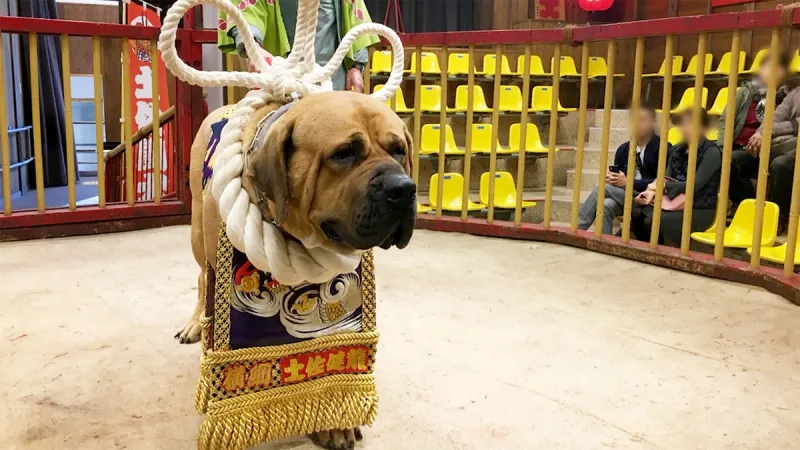
For many years, the sight of Tosa dogs entering the ring, moving with deliberate ceremony like sumo wrestlers, drew the attention of spectators and tourists. The highest ranked dogs, comparable to yokozuna in sumo, performed stylized movements that symbolized dignity and strength.
However, the way winners and losers were decided placed heavy psychological and physical burdens on the dogs. Outcomes were often judged based on behaviors such as who barked first or who turned away. These criteria relied on interpreting stress responses and conflict behaviors, not just physical dominance.
Today, as our understanding of animal welfare deepens, such practices are increasingly viewed as problematic. Many experts and animal welfare organizations now consider organized dog fighting to be incompatible with modern standards of humane treatment.
In Japan, the Act on Welfare and Management of Animals has been strengthened, and some local governments have introduced ordinances that explicitly ban dog fighting events. Longstanding permanent venues that once served as tourist attractions have closed one after another.
Internationally, the situation is even more stringent. Several countries restrict or completely prohibit the ownership of Tosa dogs, grouping them with other so-called “dangerous breeds.” As a result, global scrutiny of both Tosa dog fighting and Tosa breeding is increasing year by year.
Imagining a Future With Tosa Dogs That Do Not Fight
Given this context, some might ask whether Tosa dog culture should simply disappear. However, erasing it entirely would also mean losing a vast body of knowledge gained over generations of close interaction with these dogs.
The experience accumulated in this unique environment—from handling techniques to understanding canine body language under extreme arousal—can be reframed and applied to modern animal welfare, behavior science, and responsible training. The key question is no longer how to continue fighting, but how to preserve the dogs and the culture without making them fight.
Preserving the Culture Through Documentation
The rituals of entering the ring, the specialized ranking terminology, and the traditional ways humans and dogs interacted in this setting all form part of an intangible cultural heritage.
These elements can be preserved through written records, video, audio, and oral histories. By documenting not only the outward forms but also the meanings behind the words and gestures, we can transform them into educational resources.
Such materials can serve as:
- Regional cultural archives that explain local history and identity
- Educational content for schools, museums, and tourism programs
- Case studies in how human values around animals evolve over time
In this way, the symbolic aspects of Tosa dog culture can live on without requiring any dog to experience fear, pain, or forced conflict.
Redefining the Tosa Dog Breed for Today
If we wish to preserve the Tosa as a breed, ethical breeding standards are non-negotiable. Modern pet guardians and breeders are increasingly expected to prioritize health, temperament, and welfare over size or perceived toughness.
Experts recommend that responsible Tosa breeding programs include:
- Transparent health screening for conditions such as hip dysplasia and heart disease
- Strict avoidance of inbreeding, supported by pedigree tracking and genetic tools where available
- Lifetime care plans for retired dogs, including rehoming support and senior care
Building a sustainable breeding system means focusing on dogs that can live long, comfortable lives with stable, predictable temperaments. In the modern era, “strength” should be defined as resilience, sound health, and emotional stability, not just physical power.
From this perspective, the ideal Tosa is not the dog that wins in a ring, but the dog that can thrive peacefully alongside humans for many years.
Passing Down Training and Handling Skills
One of the most remarkable aspects of traditional Tosa handling is the dog’s ability to maintain composure, coordination, and trust in the handler even in environments designed to provoke extreme arousal.
These qualities—emotional self-control, cooperation, and deep handler-dog trust—are not only valuable in fighting contexts. They are even more important in everyday life, where dogs must navigate busy streets, veterinary visits, and interactions with unfamiliar people and animals.
The techniques developed to manage powerful dogs in high-stress situations can be redirected toward:
- Safe handling of large and giant breeds in homes and public spaces
- Behavior modification and impulse control training for reactive or anxious dogs
- Professional handling skills for veterinary teams, groomers, and trainers
By systematizing and sharing these methods, Tosa handlers can contribute to safer, more humane dog management across all breeds. The knowledge born in the ring can now support a future of coexistence instead of conflict.
Balancing Canine Happiness With Cultural Preservation
At the heart of every discussion about Tosa dogs should be a simple principle maximize the well-being of the dogs who are alive right now. When we return to this starting point, even the traditional symbol of “strength” associated with Tosa dog fighting can be reinterpreted.
Rather than celebrating the power to injure or dominate, we can honor the power to regulate oneself. A Tosa that can remain calm, respond reliably to cues, and coexist peacefully with humans and other animals embodies a new kind of strength that aligns with modern animal welfare values.
Traditional symbols such as the ring, rankings, and ornate ceremonial gear do not have to disappear. Instead, they can be reimagined and repurposed in ways that celebrate history without causing harm. For example, cultural events could showcase Tosa dogs in:
- Non-contact demonstrations of obedience and self-control
- Educational programs about responsible ownership of large breeds
- Heritage exhibitions that explain the evolution from fighting to welfare-focused guardianship
Most importantly, if preserving Tosa bloodlines can be achieved through non-fighting, welfare-centered breeding and guardianship, this would represent a meaningful form of cultural continuity. It would allow the region’s history, identity, and pride in the Tosa to endure, while giving the dogs themselves safer, happier lives.
For pet parents and communities alike, the path forward lies in choosing compassion without abandoning culture. By redefining what it means for a Tosa to be “strong,” we can build a future where tradition and animal welfare no longer stand in opposition, but move forward together.
- 03.03.2026
- 09.02.2025