Pro-Level Dog Bathing At Home Expert Groomer Tips For Salon Worthy Results
This article is an English translation of the original Japanese article. Read the original Japanese version.
Struggling to book a grooming appointment or wondering how often to bathe your dog? Learn how to safely give your pup a salon quality bath at home with groomer approved tools, techniques, and drying tips that protect their skin and coat.
Hello, I’m Anko, a professional dog groomer.
As the pet boom continues, many grooming salons are fully booked and short staffed. If you can’t get an appointment as often as you’d like, learning to bathe your dog at home is one of the most valuable skills a pet parent can have.
With the right tools, timing, and technique, home baths can be safe, efficient, and surprisingly relaxing for both you and your dog.
How Often Should You Bathe Your Dog
For most healthy dogs, bathing about once a month is a good baseline, and many experts recommend every 2 to 3 weeks if your dog gets dirty easily or has an active lifestyle.
However, some dogs with specific skin or coat conditions may need more frequent care, even several times a week, under veterinary guidance. What matters most is finding a bathing schedule that suits your dog’s skin, coat type, and daily routine, and then keeping that rhythm as consistent as possible.
Pay attention to your dog’s comfort and your own schedule. The ideal routine is one that keeps your dog clean without drying out their skin and is realistic for you to maintain.
Essential Tools For At Home Grooming
Before you start, gather your tools so the process feels calm and organized for your dog.
Slicker Brush
A slicker brush is one of the most commonly used grooming tools. It has many fine metal pins and is designed to be used with the pin surface held parallel to the skin, not poking into it.
Use it to gently work through the coat, removing loose hair and light tangles. The slight stimulation of the skin can also help promote healthy blood circulation when used correctly.
Comb
A grooming comb is mainly used to check and refine the coat after brushing. It’s also essential for finding hidden tangles and small mats.
Run the comb from the roots to the ends. If the comb catches, there is still a tangle or mat, so avoid pulling and go back to gentle detangling instead.
Hair Dryer
For most dogs, a human hair dryer is perfectly fine to use at home, as long as you are careful with heat and distance.
Choose a dryer that is reasonably powerful so drying does not take too long, which can be stressful and uncomfortable for your dog. Always keep the dryer moving and avoid high heat directly on the skin.
Towels
Prepare at least one soft, absorbent towel for your dog. Fluffy, high quality towels are gentler on the skin and coat and help remove moisture quickly without harsh rubbing.
Dog Shampoo And Conditioner
Select a dog specific shampoo that suits your dog’s skin and coat type. Avoid human shampoos, which are not pH balanced for dogs.
If you are new to home bathing or want to keep things simple, consider using a 2 in 1 shampoo and conditioner. This can shorten bath time and reduce stress for dogs who are not yet comfortable with long grooming sessions.
Helpful Extras To Consider
These tools are not strictly required, but they can make home grooming safer and more effective.
Flea Comb
A flea comb is designed to remove fleas and debris from the coat, but it is also extremely useful for cleaning delicate areas such as the inner corners of the eyes and around the mouth.
Use it gently and slowly, especially on sensitive skin.
Soft Cotton Swabs
Baby grade cotton swabs are ideal for carefully absorbing water that may have entered the outer ear during the bath.
Because a dog’s skin is delicate, baby swabs are usually softer and safer than standard ones. In professional salons, groomers often wrap cotton around a tool called a hemostat, but at home, soft swabs are usually sufficient for light drying of the outer ear area. Never insert anything deep into the ear canal.
Step By Step Guide To A Salon Quality Home Bath
Once your tools are ready, you can move through the bath in a calm, predictable order. This helps your dog feel secure and makes the process smoother for you.
Step 1 Check For Tangles And Mats
Start by parting your dog’s coat with your fingers and checking the hair close to the skin. This is where tangles and mats usually begin.
Gently insert the comb from the roots outward. If the comb snags or stops, there is a tangle or mat. Do not pull straight through, as this can be painful and damage the coat.
Pay extra attention to areas that mat easily:
- Under the front legs
- Inner thighs
- Behind and under the ears
These spots often hide tight knots that can worsen with water if not removed beforehand.
Step 2 Brush Thoroughly
Next, use the slicker brush to systematically work through the coat.
Keep in mind the key rule: “Brush with the pins parallel to the skin.” Let the tips of the pins glide over the coat without digging into the skin, and use a light, gentle pressure.
For long coated dogs, brushing only the surface is not enough. Lift and part the coat in layers, brushing from the roots outward so that the entire coat, not just the top, is tangle free.
If you are unsure about pressure, test the slicker on your own forearm first. If it feels scratchy or painful on your skin, it will be too strong for your dog.
Around the face and near the eyes, switch to the comb instead of the slicker. This gives you more control and reduces the risk of poking sensitive areas.
Once you have brushed the entire body, run the comb through the coat again from head to tail. If the comb glides smoothly without catching, you are ready to move on to the bath.
Step 3 Wet The Coat And Shampoo
When all visible tangles are gone, it is time to bathe.
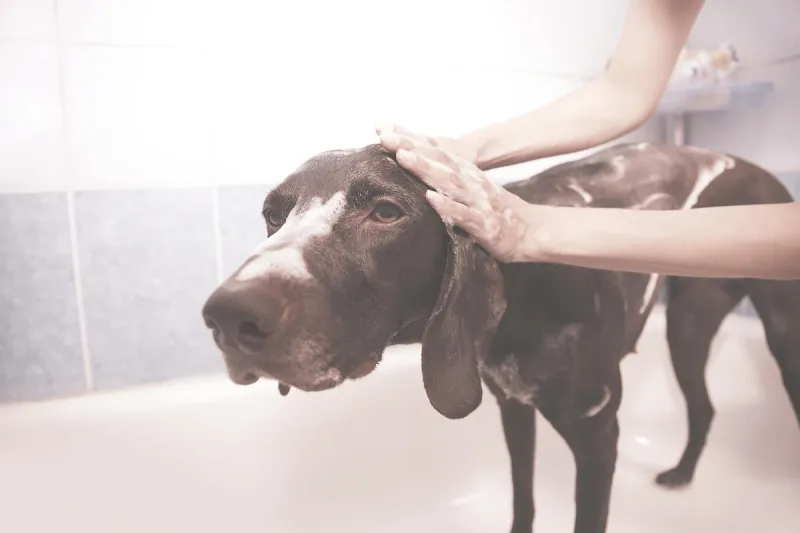
Begin by wetting your dog gradually, starting from areas farthest from the heart, such as the hindquarters and back legs. This slower approach is less startling and more comfortable for many dogs.
Many dogs are sensitive about water near their face. When you reach the head, lower the water pressure and flow, and avoid spraying directly into the eyes, nose, or ears. You can use your hand or a small cup to guide water gently.
Be especially careful to keep water out of the ear canals.
Once the coat is fully saturated, apply a generous amount of dog shampoo and work it into a rich lather, massaging down to the skin. Focus carefully on areas that tend to get the dirtiest:
- Paws and between the toes
- Under the tail and genital area
- Around the mouth
- Around the ears and behind them, where oils can build up
If shampoo accidentally gets into your dog’s eyes, rinse immediately with plenty of clean, lukewarm water.
When you are satisfied that the coat and skin are clean, rinse thoroughly. If your dog was very dirty, a second shampoo may be helpful, but for beginners, it is often better to avoid overly long baths that may stress your dog or dry out the skin.
Step 4 Condition The Coat
After shampooing, use a dog safe conditioner or rinse to help moisturize the skin and protect the coat.
Apply it evenly through the coat, including the face area where there is fur, being careful again to avoid the eyes and mouth. Conditioning helps reduce tangles, add shine, and support the skin barrier, especially for long haired or curly coated breeds.
When you are done, rinse very thoroughly. Any product left on the skin can cause itchiness or irritation, so take your time with this step.
Step 5 Towel Dry Gently
Once the coat is fully rinsed, gently squeeze out excess water with your hands, then move on to towel drying.
Use your towel to press and blot the coat rather than rubbing vigorously. Dogs’ skin and hair are more delicate than they appear, and harsh rubbing can cause friction damage and breakage.
This is especially important for long haired breeds and curly coated dogs, which can develop new tangles and mats very quickly if the coat is roughly rubbed.
Work in sections, gently pressing the towel against the coat to absorb as much moisture as possible while keeping the hair aligned.
Step 6 The Tricky Part Drying With A Hair Dryer
For many pet parents, drying is the most challenging step.
Short coated and medium coated dogs can often be dried by holding the dryer in one hand and supporting the dog with the other, keeping the dryer moving and at a safe distance.
However, for grooming breeds such as Toy Poodles and other curly or long coated dogs, simply blowing warm air until the coat is dry is not enough. If you do this, the hair is very likely to tangle and mat again as it dries.
For these breeds, the key is to brush while you dry the area where the air is blowing. This helps straighten and separate the hair, preventing mats and creating that fluffy, salon style finish.
Because this requires a dryer, a brush, and a hand to steady your dog, you may find you run out of hands. In that case, consider:
- Asking another adult to help hold and reassure your dog
- Using a dryer stand or holder that keeps the dryer in place while you brush
Some groomers balance the dryer between their head and shoulder like a phone, but this is hard on the body and not recommended, especially at home. In rare cases, dryers can overheat or malfunction, so always prioritize safety and never leave a running dryer unattended.
When drying the face, avoid directing hot air into the eyes, as this can contribute to dryness and irritation over time. Switch to a cool or low warm setting and keep the airflow gentle and indirect.
Step 7 Final Coat Check
After your dog is completely dry, run the comb through the entire coat again, from the roots to the ends.
This final check helps you confirm that there are no remaining damp spots or hidden tangles. If the comb moves smoothly and the coat feels light, fluffy, and dry all the way through, your home grooming session is complete.
Finish by praising your dog generously and offering a favorite treat or cuddle time. Positive experiences help your dog relax more with each future bath.
Growing Confidence In Your Home Grooming Routine
The basic flow of a professional grooming bath can absolutely be adapted for home use. While groomers bring specialized training and experience, pet parents and guardians are the ones who see their dogs every day.
Your dog’s lifestyle, activity level, and environment all affect how quickly their coat gets dirty and how much oil builds up on the skin. By observing these patterns, you are in the best position to fine tune the ideal bathing frequency, timing, and technique for your individual dog.
With practice, each bath becomes easier, faster, and more enjoyable. Use these steps as your foundation, then adjust as you learn what works best for your dog’s body and temperament.
Over time, home bathing is not just about cleanliness it becomes a powerful way to build trust, strengthen your bond, and support your dog’s long term skin and coat health.
- 03.03.2026
- 12.07.2018
Anco
Drawing on my experience as a grooming instructor, I am dedicated to sharing essential techniques and industry insights that are truly needed in the field.