How To Shape a Soft, Round Muzzle That Makes Your Dog Look Adorable
This article is an English translation of the original Japanese article. Read the original Japanese version.
A beautifully rounded muzzle can transform your dog’s entire expression, but many pet parents struggle to get it right at home. Learn expert-backed tips to safely shape a soft, oval muzzle that looks cute from every angle and keeps your dog comfortable.
Before You Trim The Muzzle
A cute, rounded muzzle starts with understanding the whole face. Before you focus on the nose area, take a moment to look at your dog’s overall facial design, coat type, and current haircut.
Breeds like Toy Poodles and Miniature Schnauzers are known for their abundant, curly or wavy coats. Individual dogs may have anything from tight curls to loose waves, but in all cases this texture makes them ideal candidates for stylish, sculpted grooming. Popular looks such as the classic teddy bear cut rely on this natural curl to create a soft, plush finish around the face.
When you keep the big picture in mind, it becomes much easier to decide how round, short, or fluffy you want the muzzle to appear so it matches the rest of the head.
Start With Thorough Brushing
Before any scissors or clippers touch your dog’s face, always start with careful brushing and combing. This step is essential, not optional.
If your dog is regularly groomed and brushed, you may find only minor tangles. However, many pet guardians discover hidden knots or small mats around the cheeks, under the chin, and near the muzzle. Trying to cut through these without detangling first can lead to uneven lines, accidental snips, and a shape that changes completely once you brush it out later.
To set yourself up for success:
- Brush and comb the entire face including cheeks, under the jaw, and around the eyes.
- Gently remove tangles before you start trimming so the hair lies in its natural direction.
- Check again with a fine comb; if the comb passes through smoothly, you are ready to cut.
This preparation helps you create a clean, predictable outline and reduces the risk of overcutting.
How To Approach Muzzle Trimming
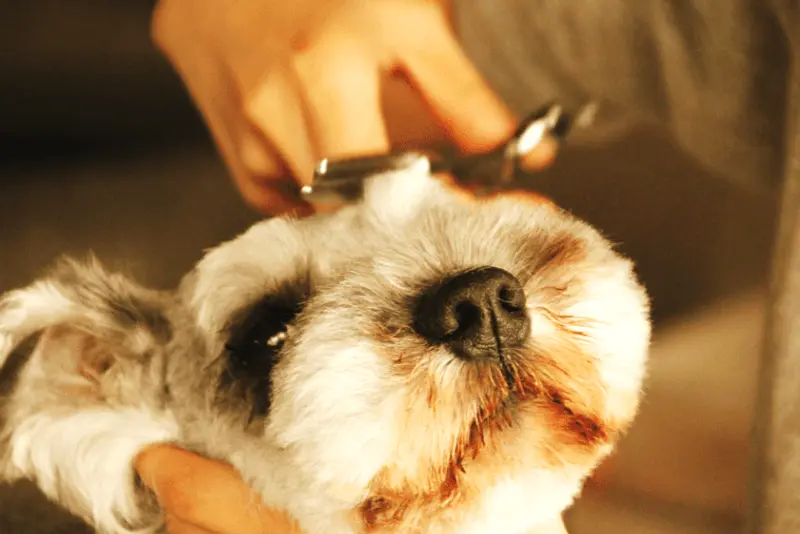
Once the face is brushed and detangled, you can focus on the muzzle. A key first step is understanding where your dog’s “nose area” actually begins and ends.
Anatomically, everything from the space between the eyes (the bridge of the nose) down to the tip of the nose is considered part of the muzzle. When groomers talk about rounding the muzzle, they are shaping this entire section into a soft, oval form that looks balanced from the front and the side.
The most important technique is to comb the hair on top of the muzzle straight upward before you trim. This allows you to see the true length of the hair and sculpt a smooth curve instead of accidentally chopping into the shape.
A simple, safe workflow is:
- Trim a very small amount of hair at a time.
- Comb the hair back into place to check the shape.
- Repeat gradually, adjusting the outline until you see a clean, gentle oval.
By consistently combing between snips, you greatly reduce the risk of cutting too short. Think of it as sculpting: you are refining the shape little by little, not trying to achieve the final look in one pass.
As you work, check the muzzle from multiple angles. It is common for the muzzle to look perfectly round from the front but appear flat or uneven from the side. Pause regularly to look at your dog head-on, from the profile, and slightly above to confirm that the curve is smooth all around.
Keeping Your Dog Comfortable During Grooming
Even a cooperative dog can become tired or restless if muzzle trimming takes too long. Remember that during most grooming sessions, dogs are standing for an extended period, which can be physically demanding.
To protect your dog’s comfort and build positive associations with grooming:
- Plan short sessions, especially if you are still learning.
- Offer breaks if your dog starts shifting, licking, or turning away.
- Use calm handling and praise so your dog feels safe and supported.
Experts recommend ending the session on a positive note, even if the muzzle is not perfectly finished. You can always refine the shape in a second, shorter session rather than pushing your dog past their limit.
Learning From Professional Grooming Videos
Written instructions are helpful, but some grooming techniques are much easier to understand when you can actually see them. Many professional groomers now share their trimming process online, including detailed footage of face and muzzle shaping.
While you should never assume anything about the content of specific links or videos, you can search for reputable grooming channels that demonstrate:
- How to hold the comb and scissors safely around the face
- How to lift and comb the muzzle hair straight up before trimming
- How to check symmetry from the front, side, and top
Watching experienced groomers work in real time can give you a clearer sense of hand position, pressure, and pacing than text alone. Consider combining what you see in videos with guidance from your veterinarian or a certified groomer who knows your individual dog.
Growing Your Skills And Your Dog’s Confidence
Perfecting a round, adorable muzzle is a skill that develops over time. Even professional groomers refine their technique through repetition, careful observation, and ongoing education.
If you are a pet parent interested in doing light maintenance trims at home, focus on safety, patience, and small improvements rather than perfection. Start by mastering brushing and combing, then practice tiny, conservative trims while regularly checking your work from different angles.
If you are a grooming professional, continuing to study videos, attend workshops, and compare techniques can help you offer even more polished, breed-appropriate styles to your clients.
In every case, your dog’s comfort and emotional well-being come first. By moving slowly, taking breaks, and using gentle handling, you not only create a beautifully rounded muzzle—you also build trust, making each future grooming session calmer and more enjoyable for both of you.
- 03.02.2026
- 05.14.2016